Why Is MIT Making Robot Insects?
There are robots the size of bees, others that can jump on water, and some that are powered by tiny combustion engines the size of a penny.
7 capitulos
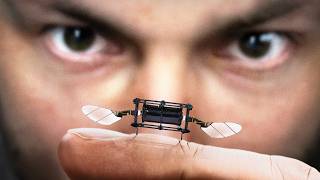
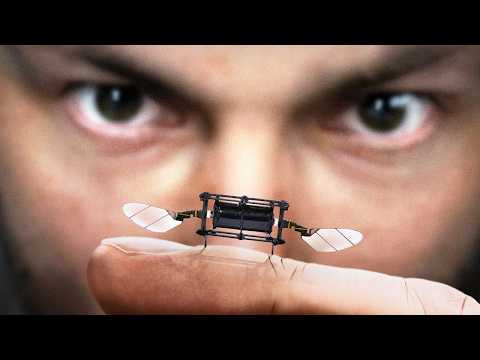
- Micro-Robots That Swim and FlyDesign OverviewTiny yellow submarine robot that weighs 175 milligrams and can both fly and swim by flapping miniature wings at different frequencies (9 times per second in water, 250 times per second in air).Surface Tension Challenge• Surface tension acts as a wall blocking transition between water and air for small robots • Water molecules are polar, creating strong cohesive forces at the surface • This same effect allows water striders to walk on pond surfacesBreaking Through• Robot splits water into hydrogen and oxygen, storing gases in buoyancy chamber • Sparker ignites gases, creating explosion that breaks surface tension and launches robot 30 centimeters into air • Another robot uses 600-volt charged copper pads to break the hydrophobic barrier and sink on commandMovement CapabilitiesRobots can walk on water using special foot pads, dive beneath surface, and walk underwater once submerged.
- The Physics of Insect-Scale FlightScale Problem• Smaller objects have higher surface area to volume ratio • 10cm cube has 0.6:1 ratio; 1cm cube has 6:1 ratio • Higher surface area relative to volume creates significant dragFlight MechanicsAt small scale, drag dominates and inertia is minimal, so soaring is impossible. Insects flap wings rapidly to generate swirling vortices above wing, creating low-pressure zones that produce lift.Design InspirationMaple tree seeds inspired robot design with unique shape that creates vortices above leading edge. Adding miniature electric rotors to wingtips generates enough lift for flight.Power ChallengesElectric motors with magnets and coils cannot scale down effectively to insect size, requiring alternative propulsion methods.
- Piezoelectric and Polymer Muscle TechnologyPiezoelectric Solution• First RoboBees used piezoelectric crystals that contract 0.1% when voltage applied • Chassis mechanically amplifies motion 30 times • Voltage switched on/off 120 times per second makes wings flapDurability ProblemPiezoelectric crystals are fragile; even small wing impacts crack them and render robot non-functional.Polymer Muscle Breakthrough• Soft polymers coated with carbon nanotubes create conducting plates • Opposite charges pull plates together stretching polymer; like charges repel causing shrinkage • Stretched up to 25% of length, amplifying force significantly • Cycling voltage hundreds of times per second drives wing movement at 400 hertzSelf-Healing Innovation• Flexible muscle withstands bumps, scrapes, and needle piercing damage • When pierced, high current burns off touching carbon nanotubes, creating self-healing effect • Scientists developed laser-assisted clearing process for laser surgery repairs
- Energy Solutions and Autonomous FlightEnergy Conservation• Hopping RoboBee conserves energy by hopping instead of continuous flight • Hong Kong drone extended flight from 6.3 minutes to 50 minutes with hopping attachment • Could be even more effective in low-gravity environments like MarsCurrent Limitations• Most robots rely on offboard sensing from cameras • Offboard power supplied externally • Offboard computation handled by external systems • Goal within five years is to combine sensing, autonomy, and power onboardBattery Constraints• Batteries need shielding for damage, short circuits, and leaks • Shielding thickness stays constant as batteries scale down, becoming increasingly inefficient • Chemical fuels have better energy-to-weight ratio than batteries at insect scaleAutonomy ProgressHarvard's RoboBee achieved short bursts of untethered autonomous flight, showing fully autonomous robot insects are within reach.
- Combustion-Powered MicrorobotsEngine Design• Penny-sized internal combustion engine runs on methane and oxygen feed • Spark ignites fuel in chamber, hot gases expand and push flexible polymer membrane acting as piston • Membrane naturally shrinks back, venting exhaust gases to repeat cycleSafety MechanismFuel line never catches fire because as explosions shrink, volume decreases faster than surface area, causing rapid heat loss to surroundings that cools the gas and stops flame from traveling backward.Control System• Robot has two combustion chambers: one for front legs, one for back legs • Sparking both sides simultaneously makes robot move straight • Sparking one side at a time makes robot pivotPerformance Specs• Robot weighs 1.6 grams (equivalent to gummy bear) • Can jump approximately two feet in air • Carries 22 times its body weight, comparable to cockroaches and beetles • Can carry fuel tank, microelectronics, sensors, camera, and battery with weight remaining
- Real-World Applications and Rescue OperationsTurbine Inspection• Aircraft turbine cracks require inspection every 3000 flight cycles or 180 days • Inspections cost tens of thousands of dollars and take full day • HAMR cockroach-inspired robot runs 10.5 body lengths per second, faster than horse in relative termsAdhesion Technology• HAMR uses special foot pads that apply voltage to polarized metal surfaces • Creates opposite charge underneath feet allowing robot to stick to metal surfaces • Works like balloon sticking to wall after rubbing on hair • Rolls-Royce and Harvard partnering to deploy HAMR inside engines for crack inspectionDisaster Response• 9/11 Ground Zero rescue deployment showed large, expensive robots got stuck and were ineffective • Ideal rescue robot should navigate tight spaces, withstand damage, operate in varied environments, be inexpensive • Material cost per robot only couple of dollars; human labor comprises main expenseSwarm StrategyPlan to deploy swarms of insect-sized microrobots to search for survivors in disaster zones, combining small size, durability, low cost, and replaceability advantages.
- Ethical Considerations and Research MotivationDystopian Concerns• Swarms of miniature robots raise fears of surveillance and weaponization from science fiction • Black Mirror episode about killer robot bees resonated with scientists working on project • Early 2000s colony collapse disorder prompted original RoboBee goal of replacing dying beesWhy Not Replace Bees• Real bees perform pollination much better and more cost-effectively than robots • Large bee colonies needed for effective pollination • From environmental protection perspective, protecting real bees makes more sense than replacing them • Better use of resources than spending money on robot bees instead of bee protectionSpy RiskRobots designed to help in disasters could theoretically be repurposed for secret surveillance, appearing as ordinary bugs.Research Philosophy• Scientists focus on fundamental science and solving technical problems rather than immediate applications • Motivated primarily by curiosity rather than commercial startup goals • Society should collectively think about preventing new technology from causing harm