The Simplest Math Problem No One Can Solve - Collatz Conjecture
10 capitulos
- Introduction to the Collatz ConjectureProblem StatementThe Collatz conjecture is a deceptively simple mathematical problem that even the world's best mathematicians have been unable to solve. It is considered so dangerous that young mathematicians are warned not to waste their time on it.Historical ContextThe conjecture is named after German mathematician Luther Collatz, who may have come up with it in the 1930s. It has many other names including the Ulam conjecture, Kakutani's problem, Thwaites conjecture, Hasse's algorithm, the Syracuse problem, and simply 3N+1.The Rules• Pick any positive integer • If the number is odd, multiply by three and add one • If the number is even, divide by two • Repeat these steps indefinitelyThe ConjectureEvery positive integer, when subjected to these rules, will eventually end up in the four, two, one loop. Mathematician Paul Erdos said, 'Mathematics is not yet ripe enough for such questions.'
- Understanding Hailstone Numbers and PatternsHailstone NumbersNumbers generated by the 3x+1 process are called hailstone numbers because they go up and down like hailstones in a thundercloud before eventually falling down to one.Stopping TimeThe total stopping time is the number of steps it takes for a sequence to reach one. For example, the number 26 has a stopping time of 10 steps, while 27 takes 111 steps and climbs as high as 9,232, which is higher than Mount Everest.Pattern VariationsDifferent numbers take vastly different paths to reach one, even when they are right next to each other. This makes it difficult to predict behavior or find patterns in individual sequences.Statistical AnalysisResearchers like Alex Kontorovich and Yakov Sinai found that the paths of hailstone numbers resemble geometric Brownian motion, similar to stock market fluctuations. The pattern appears random, like flipping a coin at each step.
- Leading Digits and Benford's LawDistribution PatternWhen analyzing the leading digits of all numbers in Collatz sequences, 30% start with one, 17.5% with two, 12% with three, and frequencies decrease for higher digits, with fewer than 5% starting with nine.Benford's LawThis distribution pattern is known as Benford's law, which appears in many natural phenomena including populations of countries, company values, physical constants, and Fibonacci numbers.Practical Applications• Used to detect fraud in income tax forms and election data • Works best when numbers span several orders of magnitude • An honest tax return should follow Benford's law • Can reveal irregularities in election numbers when applied correctlyLimitationsWhile Benford's law describes patterns in Collatz sequences, it cannot tell us whether all numbers will actually end up in the four, two, one loop.
- Mathematical Analysis and Growth FactorsGrowth ParadoxAlthough odd numbers are more than tripled while even numbers are only cut in half, sequences tend to shrink overall. This is because every odd number multiplied by three and plus one becomes even, requiring an immediate division by two.Effective Growth RateThe actual growth factor for odd numbers is approximately 3/2, not 3. From one odd number to the next, the average multiplication factor is 3/4, which is less than one, meaning sequences statistically shrink.Probability Analysis• 50% of the time, dividing by two after 3x+1 leads to another odd number • 25% of the time, you divide by four before reaching the next odd number • 12.5% of the time, you divide by eight • The geometric mean of all possibilities gives a factor of 3/4Example CalculationThe number 341 becomes 1,024 after applying 3x+1, which can be divided by two ten times consecutively until reaching one, demonstrating how even numbers enable rapid descent.
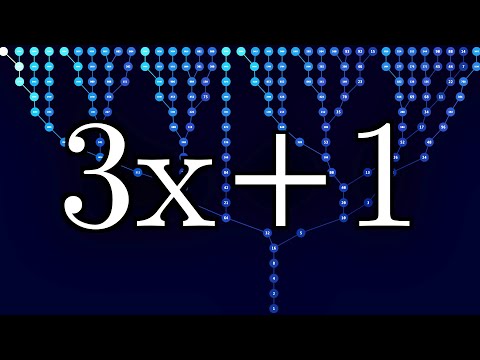
- Graph Visualization and Loop StructuresDirected GraphThe paths of numbers in 3x+1 can be visualized as a directed graph showing how each number connects to the next in its sequence. If the conjecture is true, every number eventually flows into the four, two, one loop.Artistic VisualizationSome mathematicians rotate the graph anticlockwise for odd numbers and clockwise for even numbers, creating structures that resemble coral or seaweed. By adjusting rotation degrees, beautiful organic-looking shapes can be generated.Possible Failures• A sequence could grow to infinity instead of converging to one • A closed loop disconnected from the main graph could exist • Thus far, no such counterexamples have been foundNegative NumbersWhen applying 3x+1 to negative numbers, there are three independent loops rather than one. This mysterious difference between positive and negative numbers remains unexplained.
- Computational Verification and LimitsBrute Force TestingMathematicians have tested every single number up to 2 to the 68 (approximately 295 quintillion numbers), and all eventually reach one. This represents massive computational verification of the conjecture.Loop RequirementsBased on the numbers tested, any loop other than four, two, one must be at least 186 billion numbers long. This makes discovery increasingly unlikely as the required size grows exponentially.Historical CounterexampleThe Polya conjecture, proposed in 1919, was believed true for decades until C. Brian Haselgrove found a counterexample in 1958 at the value 1.845 times 10 to the 361, which is 10 to the 340 times larger than all numbers tested for 3x+1.Scale PerspectiveOn the scale of all numbers, 2 to the 68 is negligible. Testing 68 squares worth of input should not give confidence that the conjecture holds for all inputs, especially when counterexamples can be astronomically large.
- Mathematical Progress and Proof AttemptsTerras ResultsIn 1976, Riho Terras showed that almost all Collatz sequences reach a point below their initial value. This result was progressively improved in 1979 and 1994, with the threshold lowered to numbers going below X to the power of 0.7925.Terry Tao's BreakthroughIn 2019, mathematician Terry Tao proved that almost all numbers will reach a value smaller than any arbitrary function f of x that goes to infinity. This means you can guarantee an arbitrarily small number somewhere in almost every sequence.Definition of Almost AllIn mathematics, 'almost all numbers' means that as numbers approach infinity, the fraction satisfying the criteria approaches one. This does not guarantee that all numbers satisfy the property.Remaining GapTerry Tao stated this result is 'about as close as one can get to the Collatz conjecture without actually solving it.' Despite this impressive progress, a complete proof remains elusive.
- Why Proof Remains DifficultBias Toward ProofAlmost everyone attempts to prove the conjecture true, meaning almost no one searches systematically for counterexamples. A counterexample might exist but remain undiscovered due to this bias.Search Space ImpossibilityThe space of all possible numbers is too large to search exhaustively by brute force. Two to the 1,000 is not a searchable space, so any counterexample must be found through intelligent reasoning rather than guess and check.Specifiable Behavior• Numbers can be calculated to exhibit any arbitrary finite behavior you specify • You can construct a number that increases by 3/2 five, ten, or thousand consecutive times • But after the finite section you specify, behavior cannot be controlled • Every tested number ultimately falls to oneGuessing ImpossibilityIf a counterexample exists, it is virtually impossible that someone would guess it randomly. Finding it would require either luck or a fundamental new mathematical insight.
- Alternative Perspectives and UndecidabilityFalsehood PossibilityThe difficulty in proving the conjecture could indicate that it is actually false rather than true. If everyone is struggling to prove something that is false, the struggle would be eternal, making the pattern of difficulty itself suggestive.Undecidability TheoryIn 1987, John Conway created FRACTRAN, a generalization of 3x+1 that is Turing-complete and subject to the halting problem. While this does not prove 3x+1 is undecidable, it is possible we may never prove the conjecture true or false.Halting Problem ConnectionThe halting problem shows that some computational questions cannot be answered algorithmically. The Collatz conjecture may have similar fundamental limitations that make it unprovable.Mathematical LimitsThis reveals that mathematics is harder than commonly taught in schools. The unsolved nature of 3x+1 demonstrates that we have no right to expect solutions to the many problems we can solve.
- The Peculiarity of Numbers and ConclusionNumber PatternsNumbers have always seemed like regular things full of patterns, symmetry, and repetition. The Collatz conjecture reveals how peculiar and mysterious numbers truly are.Visual BeautyThe coral representation of 3x+1 demonstrates how a simple mathematical operation produces something intricate and organic-looking. Yet this apparent complexity remains intractable to mathematical analysis.Open Questions• Do all numbers connect to the 4-2-1 structure? • Is there a unique filament that runs off to infinity? • Why is it so hard to determine the answer? • Why are there three loops for negative numbers but only one for positive?Final ReflectionPaul Erdos's statement that 'Mathematics is not yet ripe enough for such questions' captures the fundamental challenge. The Collatz conjecture exemplifies how even the simplest mathematical operations can reveal the profound limits of human mathematical understanding.