The Discovery That Transformed Pi
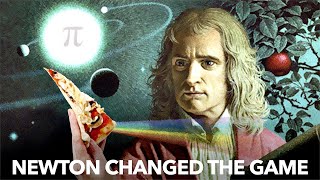
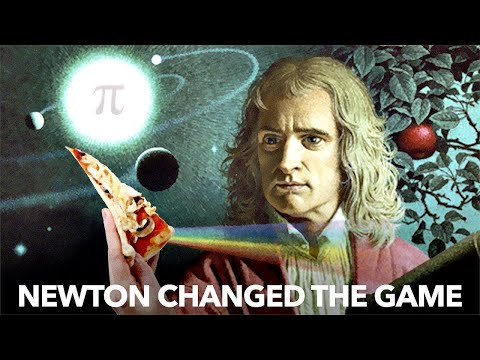
For 2000 years the most successful method was painstakingly slow and tedious, but then Isaac Newton came along and changed the game.
8 capitulos
- Understanding Pi Through PizzaWhat is PiPi is the ratio of a circle's circumference to its diameter, approximately 3.14 times the diameter.Area FormulaThe area of a circle is Pi times the radius squared (Pi R²), derived by slicing a circle into thin strips and rearranging them into a rectangle.Unit CircleA circle with radius 1 has an area equal to exactly Pi, which becomes useful for later calculations.Visual DemonstrationUsing pizza as an analogy helps illustrate how the circumference relates to diameter and how area formulas are derived from geometric principles.
- Ancient Methods: From Hexagons to ArchimedesBounds Discovery• By inscribing a hexagon inside a circle with diameter 2, the perimeter is 6, so Pi must be greater than 3 • By circumscribing a square around the circle with perimeter 8, Pi must be less than 4Archimedes' BreakthroughIn 250 BC, Archimedes improved the method by bisecting polygons (hexagon to dodecagon to 96-gon), calculating both inscribed and circumscribed versions to narrow the bounds.Mathematical ComplexityThe calculations required extracting square roots and converting them into fractions, making the work increasingly tedious with each iteration.Results AchievedArchimedes determined Pi to be between 3.1408 and 3.1429, which was remarkably accurate for over 2000 years ago and exceeded practical precision needs.
- Two Millennia of Polygon BisectionMotivation ShiftAfter Archimedes, calculating Pi to high precision became a matter of mathematical prestige and demonstrating computational power rather than practical necessity.Global Progression• The method spread through Chinese, Indian, Persian, and Arab mathematicians over 2000 years • Each generation continued bisecting polygons to higher and higher precisionNotable Achievements• Francois Viete (late 16th century) computed a polygon with 393,216 sides • Ludolph van Ceulen spent 25 years computing a polygon with 2^62 sides to achieve 35 correct decimal places of PiDiminishing ReturnsVan Ceulen's 35 digits were surpassed by Christoph Grienberger with 38 decimal places, after which this method was abandoned entirely due to Newton's revolutionary approach.
- Newton's Binomial Theorem ExpansionStarting PointIn 1666, while quarantining from the plague at age 23, Newton explored patterns in expressions like (1+X)² and (1+X)³, discovering the coefficients matched Pascal's triangle.Pascal's Triangle Pattern• The coefficients of (1+X)^N correspond to the row N in Pascal's triangle • Each value is found by adding the two numbers above it • This pattern has been discovered independently by Greeks, Indians, Chinese, and PersiansBreaking the RulesNewton extended the binomial theorem beyond positive integers to negative integers and fractional powers, even though the original formula only applied to positive integers.Infinite Series DiscoveryWhen applying the theorem to negative or fractional exponents, the result becomes an infinite series rather than a finite polynomial, which Newton verified by multiplication.
- Extending Pascal's Triangle and Fractional PowersNegative Integers• For N equals negative one, applying the binomial theorem yields an alternating series: 1 - X + X² - X³ + ... • This infinite series can be extended above row zero of Pascal's triangle with alternating signsFractional ExponentsNewton tried fractional powers like (1+X)^(1/2), which represents the square root of (1+X), and found the binomial theorem still produces a valid infinite series.Continuum of PatternsBetween any two rows of Pascal's triangle, there exists a continuum of patterns for fractional powers, where pairs of numbers add to make the number beneath them.Practical ApplicationUsing the series expansion for (1-X²)^(1/2), Newton could quickly calculate values like the square root of three by substituting X = -1/4 into a rapidly converging series.
- Calculus and the Circle FormulaCircle EquationThe unit circle is defined by X² + Y² = 1, which when solved for Y gives the top half of the circle as (1 - X²)^(1/2).Series RepresentationBy replacing X with -X², the binomial expansion gives a power series where each term is a simple coefficient times X raised to a power.Integration InsightNewton realized that integrating under the quarter-circle curve from 0 to 1 yields the area of a quarter circle, which equals Pi/4.Series IntegrationThe power series can be integrated term by term by increasing each X power by one and dividing by the new power, creating an infinite series of simple fractions.
- Newton's Revolutionary Pi CalculationInitial MethodBy integrating the series from 0 to 1 and setting X = 1, Newton obtained an infinite series formula that could calculate Pi to arbitrarily high precision.Key OptimizationInstead of integrating from 0 to 1, Newton integrated from 0 to 1/2, making the terms shrink faster since each subsequent term is multiplied by an additional factor of 1/4.Geometric InterpretationIntegrating to 1/2 computes the area under the curve from 0 to 1/2, which equals a 30-degree sector (area Pi/12) plus a right triangle with base 1/2 and height √3/2.Unprecedented Efficiency• Using just the first five terms yields Pi = 3.14161, accurate to two parts in 100,000 • To match Van Ceulen's 35 decimal places would require only 50 terms instead of computing a four-quintillion-sided polygon
- Impact and Legacy of Newton's MethodObsolescence of Old MethodsAfter Newton's breakthrough, polygon bisection methods were abandoned completely, as his series calculation could be done in days what previously took years.Technology TransformationThe shift illustrates how technological advancement makes old methods obsolete, similar to how cranes replaced ladders for building construction.Mathematical PrinciplesNewton's approach demonstrates that pushing mathematical patterns beyond their expected boundaries often yields powerful new insights and methods.Core LessonA small amount of mathematical insight can accomplish far more than brute-force computational effort, showing why innovation beats mere incremental progress.