Why Do Escalator Steps Have Teeth?
12 capitulos
- The Rome Metro Escalator DisasterThe EventOn October 23, 2018, thousands of football fans were riding an escalator at Rome's Republica station when it failed catastrophically within 30 seconds of becoming overcrowded.System Failures• Motor lost control as the crowd's weight increased • Main brake clamped down but failed to stop the drum • Auxiliary brake engaged but also failed • Stairs began to plummet uncontrollablyThe Aftermath24 people were injured as fans were flung forward, some leapt over the central barrier, and others were swept into a crushing pileup at the bottom.Investigation LaunchRome's Transit Agency sealed off the accident site and closed the station for several months while authorities ordered both technical and criminal investigations.
- The Birth of the EscalatorFirst DesignThe first escalator, called the Continuous Elevator, was invented by Jesse Reno and debuted as a theme park attraction in 1896 at Coney Island's Old Iron Pier.Early Specifications• Had no steps, just a 25-degree incline • Essentially a slow conveyor belt made of metal and wooden parts • Brought people up seven feet before they had to walk downstairs • Drew over 75,000 visitors during its two-week stayUnexpected BehaviorContrary to Reno's expectations, nobody walked on the escalator. Instead, people stood still with feet planted sideways, gripping the handrail tightly.User ExperienceWhen Harrods in England installed a similar device, the ride was so unsettling that staff had to offer brandy to men and smelling salts to women to calm their nerves.
- The Challenge of Stepping SurfacesPhysical Limits• At 12 degrees, walking on an incline becomes difficult • 25 degrees is roughly the limit of ankle flexibility • The 25-degree conveyor belt was precarious to walk on and unnerving to stand onThe Solution NeedIf a moving escalator had actual stairs instead of a conveyor belt, riders would always have a flat surface to stand on and a staircase they could climb if desired.Previous AttemptsThe revolving stairs design used a chain with stair-shaped blocks, creating a flat surface on the main incline but tilting forward at the top, making exit treacherous.Design ProblemsExtending the landing didn't work either, just creating a jagged mess for a longer distance that was equally problematic.
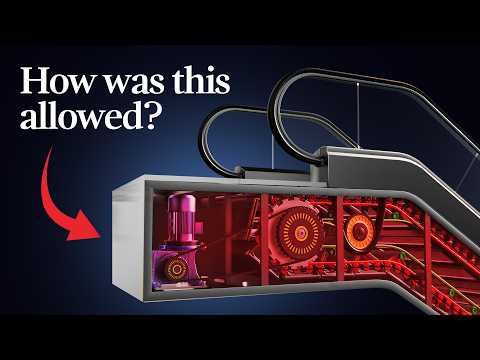
- George Wheeler's Breakthrough DesignThe InnovationGeorge Wheeler invented a system that keeps steps upright on the incline but allows them to flip upside down and tuck into the loop on the return journey, forming the basis of every modern escalator.Motor System• Electric motor outputs around 50 kilowatts (smaller than most electric cars) • Spins at over 1,000 RPM but is relatively weak • Reduction gearbox converts this to a few RPM with 100x more torqueTrack MechanismA large sprocket connects the motor to a reinforced steel chain that pulls stairs around a loop, with wheels allowing smooth rolling around curves.Step ControlEach step attaches to the chain through a single axle with freedom to rotate, plus a second set of wheels following a different track that controls the angle of each step at any point.
- From Patent to Paris ExhibitionInitial ReceptionWheeler's design caught so little attention that he was forced to shelve the idea, lacking the resources or interest to pursue commercialization.CapitalizationEight years later, another inventor named Charles Seeberger bought Wheeler's patent and partnered with the Otis Elevator Company to capitalize on the invention.World PremiereIn 1900, they showcased the world's first true commercial escalator at the Paris Exposition Universelle, which attracted 51 million visitors total to the fair.Public ReceptionFrench historian Philippe Jullian described it as the jolliest attraction, noting it separated families, sent old men sprawling, delighted children, and reduced their nannies to despair. The escalator won one of the grand prizes.
- Early Safety Issues and SolutionsDesign Problems• Early escalators had smooth flat stairs that disappeared under a wooden board at the top • Created a dangerous gap where shoelaces, coats, and long skirts easily got caught • A three-year-old girl got her foot pinched in the gap, escaping with injured toes and a missing shoeThe Shunt SolutionSeeberger and Otis installed a triangular shunt at the end forcing riders to go left before reaching the gap, but this required stepping onto solid ground while the other foot was still moving.Standing ConventionTo reduce collisions when some people stood still and others walked, operators asked people to stand on the right and keep the left lane clear for faster walkers, a convention still followed today.Modern Solution• Modern escalator steps are grooved instead of smooth • Grooves interlock with a comb plate at the top • Comb plate lifts small items up and out of harm's way • Allows people to safely step off forwards
- Advanced Safety FeaturesHandrail InnovationA separate motor connection drives a friction wheel that moves the handrail, with the handrail calibrated to move around 2% faster than the steps to compensate for friction wear over time.Practical EffectAs a friction wheel wears down its circumference decreases, moving the rubber loop a slightly shorter distance per rotation, causing the handrail to move more slowly over time.Handrail TestingYou can test this yourself by placing your hand on the handrail while standing still on a new escalator and watching your hand slowly drift forward.Speed ControlModern escalators use AC induction motors that are extremely good at regulating rotational speed, providing an unexpected benefit for downward escalators with heavy passenger loads.
- Regenerative Braking TechnologyWeight-Driven MotionOn downward escalators with enough people riding, their combined weight is sufficient that the motor no longer has to power the ride. Instead, passenger weight drives the chain and causes the motor to spin.Motor ResistanceAC induction motors create a rotating magnetic field. When the motor tries to spin faster than the field, electric currents are induced inside it, creating a magnetic field that pushes back and resists speed increase.Energy GenerationInstead of consuming energy while resisting, the motor uses excess mechanical energy to produce an electric current—a process called regenerative braking used by electric vehicles to recharge batteries.Power DistributionOn busy days, many modern downward escalators generate electricity that is channeled back to the building's internal grid and used to power other devices, including upward escalators.
- The Rome Disaster InvestigationInvestigation ReportAfter a nearly two-year investigation, investigators published an 86-page report detailing the exact sequence of events that led to the disaster.Mechanical Failures• Motor attempted to resist increasing load from crowded passengers but hit a tipping point • Safety sensors triggered power cut and main brake engagement • Main brake's braking force was only 37% of manufacturer's specification • Auxiliary brake wedges had plastic straps tied around one wedge, rendering it 50% uselessSystem SabotageError logs had been turned off, preventing automatic recording of critical malfunctions without leaving a trace. This could only happen if someone reprogrammed the system on purpose.Record FalsificationMaintenance records were incomplete with no evidence of major work on the escalator. All findings pointed to negligent maintenance and falsification by those responsible for safety rather than a manufacturing defect.
- Criminal Investigation and AccountabilityResponsibility TrailIn June 2017, maintenance responsibilities shifted to a new contractor, Metro Roma. The Transit Authority ATAC tried to distance itself, but evidence showed deeper corruption.Systemic Negligence• Metro Roma and Transit Authority ATAC worked hand in hand • Presided over negligent maintenance across the entire network • Falsified records systematically • Deliberately sabotaged safety devices to avoid escalator shutdownsLegal ConsequencesBy September 2019, 11 suspects were named and courts suspended three ATAC managers along with the chief of Metro Roma.Damning EvidenceA wiretap recorded ATAC Manager Renato Domico callously discussing how three or four more escalators might drop, appearing uninterested in the possibility of people being on those escalators.
- Safety Margins and Maintenance ResponsibilityEngineering RobustnessWhen properly maintained, escalators have enormous safety margins, with each system engineered to handle forces far beyond what they will ever experience in normal service.Material StrengthThe breaking load of an escalator step is greater than 15 kilonewtons to 1.5 tons—you could put an elephant on a step and it would not break.Catastrophic FailuresIn professional escalator maintenance experience, step breaks and step chain breaks essentially never happen, indicating the design is fundamentally sound.Critical FactorThe most important thing is ensuring the right maintenance. Catastrophic failures are vanishingly small when maintenance is done right, despite 1.5 million escalators worldwide carrying around 100 billion trips yearly in the US and Canada alone.
- The Human Element in SafetyTechnology vs PeopleWhile it's easy to blame technology when things go wrong, no matter how well-designed systems are, they all rely on people to maintain them.Duty of CareHumans have a duty of care not just to ourselves but to everyone around us, which sometimes means taking responsibility for keeping each other safe.From Problem to SolutionThe escalator's story began with one person deciding to take responsibility for a problem everyone else ignored—Jesse Reno who complained not about climbing 300+ steps to his frat house but did something about it.Problem-Solving SkillsReno had the math, the science, and most importantly the problem-solving skills to create the world's very first escalator, turning an everyday frustration into an innovation that changed the world.