How One Line in the Oldest Math Text Hinted at Hidden Universes
A single sentence in one of the oldest math books held the key to understanding our universe.
6 capitulos
- Euclid's Revolutionary Mathematical FrameworkThe ProblemBefore Euclid, mathematics suffered from circular reasoning where proofs depended on other unproven statements, creating infinite recursion of foundational questions.Euclid's SolutionHe established a system using postulates (accepted basic truths) as foundations, then built all theorems from these through logical proof, creating the gold standard for mathematical rigor.The ElementsHis 13-book series proved 465 theorems covering geometry and number theory, depending only on definitions, common notions, and five postulates.First Four Postulates• Two points can be connected by a straight line • Straight lines can be extended indefinitely • A circle can be drawn from any center and radius • All right angles are equal
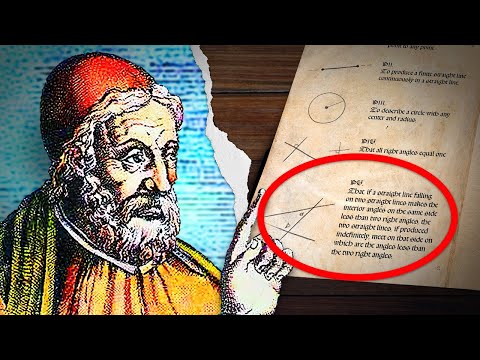
- The Suspicious Fifth PostulateThe PostulateIf a line falling on two lines makes interior angles less than two right angles, those lines will meet on that side when extended indefinitely.Why It Seemed WrongUnlike the first four simple postulates, the fifth was a complex paragraph that seemed like it should be provable from the others, leading mathematicians to suspect Euclid made an error.Failed Proof AttemptsFor over 2,000 years, mathematicians including Ptolemy, Proclus, al-Haytham, and Omar Khayyam attempted to prove it from the first four postulates, but all failed.The Parallel PostulateThe fifth postulate is often restated as: through a point not on a line, there is exactly one parallel line to the original line.
- János Bolyai's Discovery of Hyperbolic GeometryThe BreakthroughAround 1820, 17-year-old János Bolyai realized the fifth postulate might be independent of the first four, not provable from them.Alternative GeometryHe imagined a curved world where multiple parallel lines could pass through a point, discovering that straight lines on curved surfaces are geodesics (shortest paths).Hyperbolic ModelIn 1823, Bolyai created a strange new universe using the Poincare Disk Model, which fits an infinite hyperbolic plane into a finite disc, with triangles appearing smaller near the edges.Bolyai's Impact• Published his findings as a 24-page appendix to his father's textbook in 1832 • Later discovered Nikolai Lobachevsky had independently discovered non-Euclidean geometry years earlier • Left 20,000 pages of unpublished mathematical manuscripts • Believed Gauss tried to undermine him and became embittered, never publishing again
- Gauss, Riemann, and Non-Euclidean GeometriesGauss's DiscoveryCarl Friedrich Gauss independently discovered non-Euclidean geometry 30-35 years before Bolyai's publication but refused to publish due to fear of ridicule.Paradoxical Properties• In hyperbolic geometry, triangle angles become arbitrarily small for large sides • Infinitely long triangles can have finite area • All geometric theorems are mathematically consistent, unlike Euclid's predictionsSpherical GeometryOn a sphere, straight lines are great circles; any two great circles intersect, meaning there are no parallel lines, violating Euclid's second postulate.Riemann's GeneralizationIn 1854, Bernhard Riemann changed the second postulate from infinite to unbounded extension, making spherical geometry valid, and created a geometry where curvature varies from place to place in multiple dimensions.
- Geometry as Axioms and Einstein's RelativityGeometry as a GameGeometry can be viewed as a game where the first four postulates are minimum rules, and the fifth postulate selects the world: no parallels (spherical), one parallel (flat), or multiple parallels (hyperbolic).Euclid's Real MistakeEuclid's definitions like point and line create infinite recursion; modern mathematics uses undefined terms instead and focuses on relationships between objects satisfying postulates.Einstein's InsightIn 1905-1907, Einstein realized that gravity is not a force but curved spacetime; objects follow geodesics (straight lines) through curved geometry, explaining orbital motion without acceleration.General Relativity FoundationEinstein's general theory of relativity is fundamentally based on Riemann's curved geometries, using the behavior of straight lines in curved space to describe how massive objects curve spacetime.
- Observational Proof and Universe's GeometryGravitational LensingIn 2014, astronomers observed the same supernova in four different places because a massive galaxy between it and Earth curved spacetime, creating multiple light paths.Testing Universe ShapeTo determine if the universe is flat, spherical, or hyperbolic, astronomers measure triangle angles: flat adds to 180°, spherical to more, hyperbolic to less.CMB MeasurementsUsing the Cosmic Microwave Background (from 380,000 years after the Big Bang), astronomers create cosmic triangles to measure universe curvature without the scale problems Gauss faced with mountains.Results• Planck mission data shows the universe is flat within measurement error • Curvature is 0.0007 ± 0.0019, essentially zero • One more hydrogen atom average density would make it spherical; one less would make it hyperbolic • The flatness appears remarkably serendipitous given the precision required