Mars Helicopter (before it went to Mars)
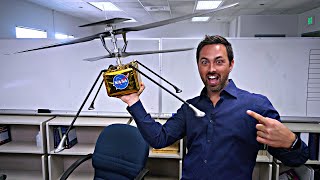
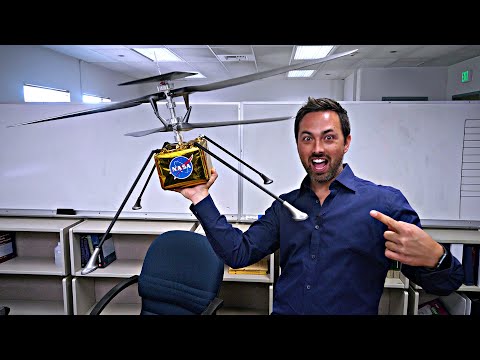
I'm at the Jet Propulsion Laboratory in Pasadena, and I'm here to see the first drone that's gonna fly on another planet.
9 capitulos
- Introduction to the Mars HelicopterHistoric AchievementThis is the first powered flight on another planet. It's part of the Mars 2020 mission and will be the first helicopter to take off and land on Mars.ContextThe Soviet Vega missions deployed helium balloons on Venus in 1985 that transmitted data for over 46 hours. However, powered flight on another planet has never been achieved before.Key ChallengeFlying on Mars is equivalent to flying at 100,000 feet on Earth. Mars has only 1% of Earth's atmosphere, making it an extremely difficult flying environment.Physical Specs• Vehicle mass is less than 1.8 kilograms (about four pounds) • Each blade weighs 35 grams, made of foam core with carbon fiber layup • Designed to fly up to 90 seconds
- Atmospheric and Design ChallengesAtmosphere ComparisonMars has a cubic meter of air weighing only 15-18 grams, compared to about one kilogram on Earth. This means the helicopter must push enormous amounts of air to generate lift.Rotor Speed• The Mars helicopter blades spin between 2,300 and 2,900 rpm • Earth helicopters typically spin at around 500 rpm, so Mars helicopter blades are five times faster • Blade tips are kept to below 0.7 Mach (70% speed of sound) to avoid shockwaves and transonic aerodynamic issuesWeight ConstraintsKeeping mass contained during the entire design process was the major challenge. Every single part had to be considered to minimize weight while maintaining structural integrity.Design ChoiceTwo counter-rotating propellers were chosen instead of a quadcopter design. This provides the simplest design and generates lift more efficiently when stacked vertically.
- Testing and Simulation on EarthEarth Test LimitationsThe Mars helicopter cannot fly on Earth due to the thick atmosphere. It would make noise but likely wouldn't achieve full rotor speed.Testing Chamber• JPL uses a 25-foot space simulator chamber • Can simulate any atmospheric pressure desired, from Martian to Earth pressures • Allowed them to test aerodynamic aspects of flightGravity OffloadTo simulate Mars's 38% gravity on Earth, engineers used a gravity offload system. This high-tech fishing reel setup with a brushed DC motor pulled on the helicopter with a fishing line to offset the difference in gravity.Sound CharacteristicsDespite the thin atmosphere, the helicopter is quite loud in the chamber, characterized as sounding like a 'baaaaaaaaah.' The thin air doesn't absorb sound effectively.
- Flight Control and AutonomyControl Systems• Helicopters use collective (changes pitch uniformly for height control) and cyclic (modulates pitch as blades rotate for directional control) • Collective controls pitch to go up or down • Cyclic provides asymmetric torque to pitch and roll the vehicleHuman Control ChallengesEarly attempts to fly the helicopter with a joystick from Earth proved nearly impossible. The aerodynamic delay and 20-minute communication delay between Earth and Mars make manual piloting unfeasible.Autonomous Flight• Onboard sensors include gyros, accelerometers, camera, altimeter, and inclinometer • State estimation happens continuously at hundreds of Hertz • Closed-loop control algorithm sends corrections to blades continuouslyControl OutcomeWhile the helicopter appears calm and controlled in flight videos, the control systems are working extremely hard internally. Blades are continuously being adjusted to maintain stable flight.
- Environmental Resilience and PowerDust Storm ToleranceMars dust storms appear aggressive in movies but are actually not dangerous due to the thin 1% atmosphere. There is very little matter actually hitting the helicopter, though there is enough air to lift it.Wind Testing• Engineers built a wind tunnel inside the 25-foot chamber using 960 computer fans • The fan array is called an open cross-section wind tunnel • Tests confirm the vehicle can handle 11 meters per second wind speedsBattery and Power• Battery capacity is between 35-40 watt hours (equivalent to three smartphone batteries) • Recharges completely over a full Martian day • Can theoretically perform one flight per dayThermal Management• Must survive temperatures as low as minus 80 to minus 100 degrees Celsius at night • Approximately two-thirds of battery energy goes to keeping electronics warm • Only one-third of energy is available for actual flight
- Structural Design and InsulationComponent Arrangement• Solar panel and antenna on top • Rotor system in middle • Fuselage cube at bottom containing batteries and circuit boardsThermal InsulationThe fuselage is a ring of batteries surrounded by circuit boards, enclosed in a shell. CO2 gas is used as the insulation material to keep the helicopter warm without adding weight.Material ChoiceAerogel was considered but rejected in favor of CO2 gas as an insulator. The simpler CO2 solution was sufficient to meet thermal requirements while saving critical weight.Design PhilosophyEvery design decision prioritizes weight reduction. Even the choice of insulation material was driven by mass constraints rather than theoretical optimality.
- Launch and Deployment SequenceLaunch Survivability• Must survive launch loads exceeding 80G from vibration • Must survive seven-month journey with radiation exposure • Must withstand nine Gs during entry into Martian atmosphereStorage and DeploymentThe helicopter is stowed underneath the rover on the belly pan. Multiple explosive charges are used to rotate it right-side-up and drop it on the surface.Release MechanismThe rover holds the helicopter with a bolt that must be released. Instead of mechanical means, the bolt is blown up using a frangibolt, which undergoes a phase transition to increase stress and break apart.Wake-up and ActivationAfter deployment, the rover drives about 100 meters away. The helicopter waits for an internal two-hour timer, then wakes up and listens for RF transmissions from the rover before attempting flight.
- First Flight Operations and PlanningCommand StructureThe rover base station issues the fly-now command. Due to the 20-minute communication delay between Earth and Mars, sequences must be pre-programmed rather than controlled in real-time.First Flight GoalThe first flight will attempt a selfie, fitting for the modern age. This serves as a simple but achievable initial mission objective.Optimal Flight Time• Best time to fly is 11 AM local Mars time • By this time, battery has charged from overnight survival heating • Sun has warmed the atmosphere to reduce heating requirements • Still early enough to avoid afternoon wind pickup and air density reductionFuture ExplorationAfter the first couple of flights succeed, engineers plan to attempt afternoon flights and more exploratory missions. The initial conservative approach prioritizes success before attempting riskier operations.
- Mission Purpose and Future ApplicationsTechnology DemonstrationThe Mars helicopter is primarily a technology demonstration to prove that powered flight on another planet is possible. This is the main objective, not scientific discovery.Current CapabilitiesThe helicopter can take color photos and videos, but these are secondary functions. The primary purpose is gathering engineering data to inform future aircraft design.Future Aircraft Concepts• Larger 30-kilogram helicopters carrying 2-kilogram science payloads for exploration • Scout aircraft flying ahead of future rovers to survey terrain • Sample collection vehicles that retrieve materials for central lander analysis • Standalone craft exploring areas inaccessible to rovers or humansExploration PotentialAircraft can access polar ice caps, cliff sides, and other remote locations. They are faster than rovers and provide higher resolution imagery than orbital spacecraft, making them valuable companions for future exploration missions.