

Anti-Gravity Wheel?
5 capitulos
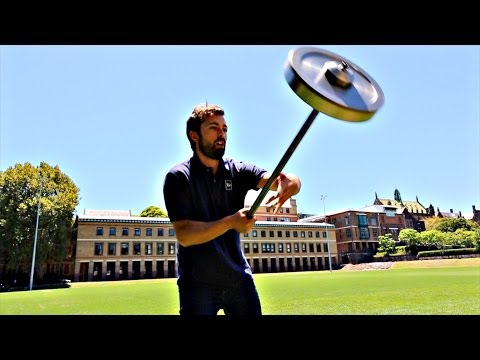
- The Impossible Horizontal HoldSetupA 19-kilogram (40-pound) flywheel is mounted on a meter-long shaft at the University of Sydney's mechanical engineering shop. The demonstration begins by attempting to hold this apparatus horizontally with one hand, which proves impossible without spinning.The Challenge• Two people attempt to hold the stationary shaft horizontally • The weight makes it extremely difficult to maintain horizontal position • Clear that static weight alone makes this task nearly impossibleThe Spin-UpThe flywheel is spun up to a few thousand RPM, and then the demonstrator attempts to hold it horizontally from one end with just one hand.The Result• The shaft remains horizontal while spinning • The wheel appears weightless as it rotates • The spinning creates an unexpected counterintuitive effect
- Understanding Gyroscopic PrecessionThe PhysicsInstead of pulling the wheel down to the ground as expected, the weight of the wheel creates a torque which pushes it around in a circle.The PhenomenonThis behavior is recognized as gyroscopic precession, a fundamental physics principle governing spinning objects.Further StudyThe video references a detailed explanation available in another video on the topic for viewers wanting deeper understanding.Next ChallengeThe demonstrator prepares to attempt a more extreme feat: lifting the spinning wheel over his head with one hand.
- Baseline Strength TestThe SuggestionBefore attempting the overhead lift with the spinning wheel, Rod wisely suggests first testing whether the demonstrator can lift the stationary wheel above his head.Static Lift Attempt• The demonstrator struggles significantly to lift the stationary 19-kilogram flywheel • Requires considerable effort and awkward maneuvering with his hand • Eventually lifts it just barely above his head with difficultySelf-AssessmentThe demonstrator humorously acknowledges his lack of strength, admitting 'clearly I do not' lift easily.PreparationDespite his limited strength, the demonstrator prepares to attempt the spinning wheel lift, requesting that the wheel be spun as fast as possible to maximize the gyroscopic effect.
- The Spinning Overhead LiftMaximum Spin-UpThe flywheel is spun up to maximum RPM (approximately ten additional seconds beyond initial spin-up) to give the best chance of success.The Lift Attempts• First attempt: Successfully lifts the spinning wheel over his head with one hand • Second attempt: Completes the lift again smoothly • Third attempt: Another successful overhead lift, demonstrating consistencyThe SensationThe demonstrator describes the spinning wheel as feeling 'incredibly, incredibly light' while lifting it over his head, a stark contrast to the stationary weight.The ParadoxDespite the wheel feeling weightless during the spinning lift, the demonstrator and assistant acknowledge that the wheel is not actually weightless and cannot be released without it crashing to the ground.
- Weight Measurement ExperimentScale BaselineThe demonstrator's weight on a scale is measured at approximately 72 kilograms.Static AdditionWhen the stationary flywheel is picked up, the scale reading increases to about 91 kilograms, confirming the 19-kilogram weight of the flywheel (approximately 42 pounds).The QuestionThe flywheel is spun up to maximum RPM, and viewers are asked to predict whether the scale reading while lifting the spinning wheel overhead will be more than, less than, or equal to 91 kilograms.Prediction ChallengeThe demonstration sets up an interactive element where viewers can make their prediction via on-screen annotations or a link in the description.