Why Don’t Railroads Need Expansion Joints?
8 capitulos
- Introduction to Thermite and Early Rail ProblemsThermite DiscoveryHans Goldschmidt discovered that metal oxide like rust can react with aluminum powder to produce pure liquid metal through thermite reactions.Early Rail Issues• Rails were originally produced in 12-meter lengths and bolted together using fish plates • Gaps between rail sections created the signature ta-tak sound and caused track flexing • Frequent gaps led to train rocking, wheel wear, and increased vibrations requiring regular maintenanceTemperature ChallengeRails shrink in winter cold and expand in summer heat, with a 40-degree Celsius temperature increase causing a 12-meter rail to grow by 6 millimeters.Initial ResistanceRailroad managers feared that welding rails together would cause them to buckle and derail in summer heat without gaps to accommodate thermal expansion.
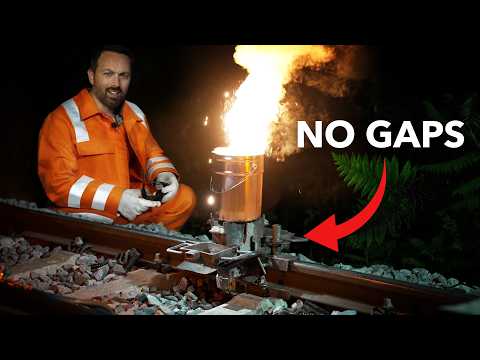
- First Thermite Welding Adoption and SetupEarly AdoptionTram rails in cities were the first to adopt thermite welding because they were much smaller than railroad tracks, resulting in smaller thermal forces.Filming LocationDerek performed eight steps of the thermite welding process in the German countryside, where professionals conducted approximately 150 welds that night.Neutral TemperatureRails are welded at their neutral temperature, a predefined temperature where the rail has zero internal stress, to account for future thermal expansion and contraction.Gap PreparationThe first step is creating a 2.5-centimeter gap by cutting the end of one rail, which can be done with a circular saw in the field or with a torch by professionals.
- Rail Alignment and PositioningAngled SetupBoth rails are angled slightly upward toward the gap because liquid thermite steel contracts as it cools, and greater contraction force at the top requires the upward angle to end up perfectly flat.Vertical AlignmentUsing wrenches and hammers, both rail ends are adjusted to the same height, requiring precise measurement and repeated hammering to achieve correct positioning.Horizontal AlignmentRails must be aligned horizontally as well, but adjusting horizontal alignment can disturb vertical alignment and vice versa, making this a frustrating iterative process.Twist Detection• One rail can be slightly twisted relative to the other, detected by misalignment at the foot of the rail • Maximum tolerance allowed is 2 millimeters • If exceeded, the twist must be corrected by untwisting the rail, which disturbs all previous alignments
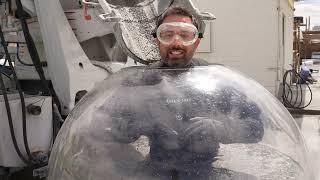
- Mold Setup and Preheating ProcessMold AssemblyA clamping device holds the mold shoes and preheating torch in place, with molds lined inside the shoes and aligned to create a watertight seal for the liquid steel.Sand SealingSand with high clay content is packed around all sides of the mold to completely seal it, preventing liquid metal from spilling out during pouring.Preheating Importance• Removes moisture and volatiles from the mold to prevent bubbles in molten steel • Heats both rail ends, which is crucial because heat transfer depends on the temperature difference between materials • Cold rails would cool the liquid steel too rapidly, creating problemsCooling DemonstrationTwo steel samples were heated and cooled differently: one rapidly in water became brittle martensite, while the other cooled slowly in sand remained flexible, showing how cooling rate affects steel properties.
- Thermite Ignition and PouringTiming CriticalThe thermite must be ignited immediately after turning off the preheating torch, with 1.5 minutes available before the mold must be removed.Chemical ProcessThe thermite reaction produces molten steel and molten aluminum oxide, with the slag floating on top due to lower density and flowing out the sides into slag pans.Pouring SequenceLiquid steel enters first and sinks to the bottom, while aluminum oxide slag floats on top and is directed away, ensuring no slag mixes with the steel.Thermal PropertiesThe power radiated by something thermally is proportional to temperature to the power of four, meaning slight temperature increases result in huge increases in brightness and power.
- Cooling, Cleanup, and FinishingCooling TimingSteel must cool long enough to become solid but not too long, otherwise excess steel and slag become difficult to remove, requiring precise timing judgment.Excess Removal• Slag pans and mold shoes are removed after cooling • A weld shear machine creates up to 20 tons of force to shear off excess steel from the weld top • Remaining excess parts are hammered offGrinding ProcessThe weld is ground down to match the exact rail level, with two phases: rough grind first, then fine grind, leaving maximum 1 millimeter of material while grinding only the top surface.Professional ExpertiseProfessional welders work much faster and more efficiently than Derek, leaving the weld glowing hot as they move on to the next task.
- Weld Testing and Microscopic AnalysisQuality TestingEvery 200 welds, one test weld is created and analyzed for chemistry, hardness, and bending properties to ensure consistent quality and safe operation.Bending TestA bending press applies force from top to bottom on the welded rail section, with the test weld failing at just over 150 tons of force, breaking in the heat-affected zone rather than the weld itself.Three Structural Zones• Original rail with horizontal grain from rolling in the steel mill • Thermite steel in the middle with solidification-front grain and microscopic center pores • Heat-affected zone between normal rail and thermite steel, where crystal structure changed from heating, making this the weakest zoneMicroscopic BondingAcid etching reveals the different crystal structures in each zone; the liquid steel melts some of the original rail to form a strong bond, with German regulations requiring melting of about 3 millimeters from each rail for robustness on construction sites.
- Annual Production and Thermal Expansion SolutionGlobal Production Scale• Around 2 million thermite welds are performed every year globally • Approximately half use Goldschmidt's thermite • Each weld creates about 2.5 centimeters of rail, totaling 50 kilometers of railroad created annually from liquid steelStress-Strain RelationshipMechanical stress can change rail length; pushing compresses it and pulling lengthens it, with the fractional length change called strain, and stress-strain showing a linear relationship for elastic deformation.Dual CompensationThermal expansion and mechanical stress can compensate for each other; sleepers pin down the rail and ballast locks sleepers in place, so thermal expansion doesn't lengthen the rail but increases compressive stress instead.Why No Expansion Joints• Continuously welded rails avoid expansion joints entirely • Allows trains to go faster with fewer bumps and vibrations • Results in much less maintenance overall • Railroads use high neutral temperatures because cracked rails in winter are less problematic than buckled rails in summer