

Testing the US Military’s Worst Idea
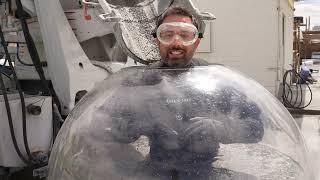
We are strapping these giant metal weights to the belly of that helicopter, flying it up several kilometers in the sky and then dropping these weights on a sandcastle city.
7 capitulos
- The Origins of Rods from GodHistorical ContextIn the late 1950s, the Soviet Union launched Sputnik on October 4, 1957, and tested the first intercontinental ballistic missile (ICBM) capable of delivering nuclear warheads to US East Coast cities in around 30 minutes.The ConceptBoeing researcher Jerry Pournelle proposed Project Thor, a space weapon using telephone pole-sized tungsten rods in orbit that could strike any location on Earth in 15 minutes, destroy targets buried 30 meters underground, and theoretically intercept ICBMs mid-flight.Impact CharacteristicsThe tungsten rods would re-enter the atmosphere at orbital speeds of about 8 kilometers per second, slowing to approximately Mach 10 (3 kilometers per second) on impact, delivering kinetic energy equivalent to the largest conventional explosives ever detonated.Weapon Evolution• In the 1980s, the Reagan administration considered the kinetic missile interceptor idea, codenamed Brilliant Pebbles • In 2003, the Air Force resurrected the concept as hypervelocity rod bundles, colloquially known as Rods from God • The project was ultimately abandoned due to feasibility issues
- Physics of Kinetic EnergyEnergy FormulaKinetic energy is directly proportional to mass and velocity squared. Increasing mass by 10 times increases kinetic energy by 10 times, but increasing velocity by 10 times increases it by a factor of 100.Real-World Dangers• A 15-gram piece of plastic traveling at 6 kilometers per second can penetrate aluminum blocks • Micro meteorites, small bolts, and paint flecks pose serious risks to astronauts on the International Space Station • A tiny speck of dust caused a chip in the ISS window; space junk punctured a hole in the robotic armCrater FormationMoon craters are circular because asteroids impact at such incredible speeds that kinetic energy becomes explosive, turning ground into liquid and gas that spray outward symmetrically, regardless of impact angle.Weapon Advantages• Kinetic impacts create explosions as powerful as the largest conventional weapons • Rods can penetrate 30 meters of soil to destroy bunkers and silos with precise surgical strikes • Unlike nuclear weapons, there is no radioactive fallout or violation of international laws
- Desert Test Setup and First AttemptsPreparation• Professional sandcastle builders, seven-time US Open Sand Castle Champions, constructed a detailed city in the desert as the target • The team built a swimming pool as a practice target for aiming accuracy • Targeting would be done using GPS coordinatesFirst DropA 100-kilogram weight was dropped from 500 meters onto the swimming pool. The rod accelerated for 10 seconds and hit the ground at approximately 350 kilometers per hour with nearly half a million joules of kinetic energy.Aiming Challenges• Despite both helicopter and ground crews showing the same GPS coordinates, the first drop missed the swimming pool considerably • Wind and altitude perception made it extremely difficult to judge positioning • The team acknowledged that hitting targets from height was significantly harder than expectedLow Altitude ApproachAfter the GPS targeting failures, the team switched to visual aiming at lower altitudes, starting with a cube drop from approximately 100 meters, which landed about 60 feet off target.
- Successful Pool Impact and Sandcastle StrikesPool Hit AchievementFrom a 50-meter altitude, a 200-kilogram weight successfully struck the edge of the swimming pool, ripping right through it and sending rubber duckies flying.First Sandcastle AttemptDropping from 100 meters, the rod landed just in front of the sandcastle city, narrowly missing the US Capitol building, demonstrating the extreme difficulty of precise targeting.Direct Building HitOn a subsequent attempt, a rod achieved a direct hit on a sandcastle building, creating cracks but only partially destroying one side, rather than causing complete devastation.Key FindingThe results showed that kinetic weapons would be suitable for pinpoint strikes on specific targets rather than mass destruction, revealing the weapon's limited utility for widespread damage.
- Material Properties and AerodynamicsWhy Tungsten• Tungsten is extremely dense, with a cubic meter weighing 19 tons, more than twice the density of steel • For a given amount of mass, tungsten rods can be less than half the volume of steel, encountering less atmospheric resistance • Tungsten has the highest melting point of any metal at nearly 3,500 degrees CelsiusRe-entry BenefitsTungsten's high melting point means rods require much less shielding to prevent melting during atmospheric re-entry, where significant heat builds up.Aerodynamic DesignRod-shaped projectiles are ideal for minimizing drag and hitting targets with maximum speed, similar to how arrows, bullets, and ballistic missiles are designed for aerodynamic efficiency.Design MistakesThe experimental rods lacked fins, which caused them to fall on their sides and tumble unpredictably. Fins would have improved stability and accuracy during descent.
- Practical and Strategic LimitationsAiming Difficulties• Steering a rod at hypersonic speeds is theoretically possible using thrusters or fins but incredibly difficult in practice • Communicating with a rod in flight would be nearly impossible due to superheated plasma surrounding it • The test demonstrated that hitting moving targets or precise locations from high altitudes is extremely challengingOrbital Mechanics Issues• Placing rods in geostationary orbit (35,000 kilometers away) would require several hours for them to fall to Earth • Low Earth orbit placement would mean rods take up to 90 minutes to complete a revolution, resulting in strike times of up to an hour and a half • A 15-minute response time would require approximately 100 rods spread across multiple orbits at billions of dollars in costMissile Defense Challenges• Intercepting ICBMs requires hitting them during boost phase before they split into multiple payloads and decoys • Defending against North Korean launches would require around 400 rods across eight orbits, with a global system needing several times that amount • Enemies could overwhelm the system by launching multiple missiles simultaneouslyEconomic Infeasibility• A limited missile defense system would cost approximately 300 billion dollars, nearly half the US military annual budget • Ongoing maintenance costs would be substantial as thrusters break down and malfunction over time • The weapon system would ultimately be more expensive and less reliable than conventional military alternatives
- Conclusion and LegacyTest ResultsThe experimental drops revealed that precise aiming of kinetic projectiles is extremely difficult, preventing a full demonstration of the weapon's explosive power that would have occurred at higher altitudes and greater masses.Weapon AssessmentRods from God are unfeasible to execute in reality due to overwhelming practical, technical, and economic challenges including aiming, communication, orbital mechanics, and cost.Creator's JourneyJerry Pournelle, the Boeing researcher who conceived the idea, later became a science fiction writer and incorporated kinetic weapons into his 1985 New York Times bestselling book Footfall, where aliens use them to invade Earth.Broader LessonThe concept remains feasible only in science fiction, and engineering is fundamentally about trying, failing, and learning from experiments to understand what is and isn't practical in reality.