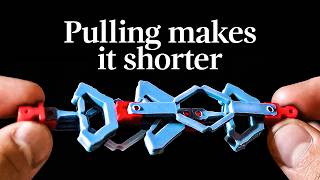

This mechanism shrinks when pulled
5 capitulos
- The Paradoxical Spring MechanismThe PhenomenonA mechanism that contracts when pulled instead of stretching like normal springs. When water is added to a cup hanging from the mechanism, the cup shoots upward rather than falling.Initial ConfusionPeople predict the weight will fall when the green rope is cut, but in slow motion footage, the weight moves upward instead.Technical Explanation• Springs connected in series extend twice as much as springs connected in parallel • When the green rope is cut, springs transition from series to parallel configuration • This transition causes contraction because each spring now carries less weightThe Key PrincipleThe slack ropes must be precisely calibrated—long enough to create the illusion of falling, but not so long that they prevent the contraction effect.
- Braess's Paradox and TrafficThe DiscoveryGerman mathematician Dietrich Braess discovered in 1968 that adding new roads to a network can paradoxically make traffic worse, not better.The Scenario• Two identical routes cross a town—one with a wide highway followed by a narrow street, the other reversed • Adding a connecting road creates a shortcut through both narrow streets • Individual drivers rationally choose the shortcut, but collectively this causes congestionReal-World ProofDuring Earth Day 1990, New York closed 42nd Street for 6 hours. Traffic in the surrounding area improved by 20%, reducing car numbers despite predictions of chaos.Widespread Impact• Mathematicians identified 12 redundant roads in New York that could improve traffic if removed • The paradox appears in Boston, London, and Seoul • Affects any network system—power grids, food chains, the internet, blockchain
- Network Paradoxes and ApplicationsBeyond Traffic• Power grids can become unstable or experience blackouts when capacity is increased or new lines added • Food chains, blockchains, and the internet can all become worse when elements are added • Less information online about yourself is better for privacySponsor IntegrationIncogn removes personal data from data brokers. The presenter sent one email and received spam from multiple sources, demonstrating data broker proliferation.Series-Parallel ConnectionThe spring mechanism is the physical equivalent of Braess's paradox—springs in series extend more than springs in parallel, and switching between configurations changes overall length.Paradox ConditionsBraess's paradox requires very specific conditions to occur. When successfully implemented, it creates a mechanism that shrinks when pulled.
- The Counter-Snapping MechanismNormal vs. Reversed• Normal snapping: keyboard buttons, straws, and eyeglasses fail by suddenly moving in the direction of applied force • Counter-snapping: materials move opposite to the applied force, which feels counterintuitive and violates expectationsComponent BehaviorThe mechanism consists of three components: side springs that are very stiff, top and bottom springs that feel springy, and a central piece that snaps out suddenly.Dynamic Switching• Tension builds in the three middle pieces while sides remain relaxed • The centerpiece suddenly snaps out, transferring tension to side springs • The system switches from series to parallel configuration • Releasing the force causes the system to resetForce-Displacement GraphThe mechanism creates a looping graph with two curves—one for the series state and one for parallel. At the tipping point, displacement jumps back instead of continuing forward.
- Practical Applications and PropertiesStiffness Control• At a specific force, the series and parallel curves overlap, making the mechanism the same length in both states • You can switch between states with a small tug without changing length • This allows changing stiffness without changing lengthResonance Frequency• In series state: natural frequency is 3.7 hertz • In parallel state: natural frequency is 6.4 hertz • The mechanism can almost double its natural frequency without changing lengthVibration ControlWhen vibrated at 3.5 hertz (near series resonance), the mechanism switches to parallel state and reduces vibrations. The same works in reverse at 6.4 hertz, moving the resonance point to suppress oscillations.Future Potential• Could replace traditional tuned mass dampers for vibration control in structures • Researchers are exploring variants, such as balloons that deflate when inflated • The principle is still in early stages but shows promising applications