
Making Liquid Nitrogen From Scratch!
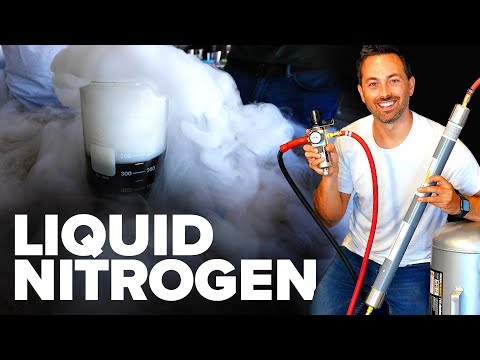
They challenged me to liquify nitrogen out of the air, and that's what I'm gonna be doing in this video.
7 capitulos
- Introduction and Nitrogen OverviewNitrogen Facts• Nitrogen is a fundamental building block of life • Makes up 78% of the atmosphere • Found in Starbucks Nitro Cold Brew as micro bubblesChallenge SetupStarbucks challenged to liquify nitrogen out of the air and demonstrate how it works in their beverage.Product ExperienceNitro Cold Brew is subtly sweet, cold, and frothy without added sugar due to nitrogen infusion.Project GoalLiquify nitrogen from the atmosphere to understand its properties and applications.
- Building the Cryo-Cooler SystemHow It Works• Cryo-cooler contains helium gas and pistons • Compression heats the gas, heat is ejected through a heat sink • Expansion cools the gas to below -200°C (cryogenic temperatures)First TestAttempting to liquify air from the room as a simple proof-of-concept to verify the system works.Team MemberAllen Pan, a YouTube creator known for advanced projects and previously shooting liquid nitrogen, assists with the experiment.Initial ResultsAfter 4 hours of running the cryo-cooler, successfully produced 50 millilitres of liquid air, condensed from approximately 35 litres of room air.
- Extracting Liquid Oxygen and Scaling UpOxygen Separation• Liquid oxygen is paramagnetic, attracted to permanent magnets • Using magnets to extract liquid oxygen droplets from liquid air • Testing with a matchstick shows oxygen supports combustion, confirming liquid oxygenNext PhaseMoving from proof-of-concept to scaling up the system to produce liquid nitrogen more efficiently.Equipment UpgradeSetting up a larger stand for the cryo-cooler to handle increased volume and moved to garage workspace.Pure Gas StrategyPlan to use pressurised air to produce pure nitrogen, then cool it to liquify for better results than liquid air.
- Nitrogen Membrane PurificationEquipment Setup• Air compressor at 10 atmospheres pressure • Filter to remove water vapour • Nitrogen membrane with hollow polymer fibresHow Separation WorksSelectively permeable polymer fibres allow oxygen, carbon dioxide, and water vapour to diffuse out faster than nitrogen, leaving high purity nitrogen.Optimization MethodHigh pressure and slow flow rate are essential; calculated that 6 minutes to fill the tank at 100 psi yields 98% pure nitrogen.Purity ResultsSuccessfully achieved 99.7% pure nitrogen with only 0.3% oxygen remaining, far exceeding initial expectations and winning a $100 bet.
- First Scaling Attempt and TroubleshootingSystem Setup• Upgraded to larger dewar for better insulation • Connected nitrogen supply to cryo-cooler system • Variac to control power, cooling fan for cryo-coolerInitial ProblemAfter 3 hours of running, no liquid nitrogen was produced; thermometer never reached expected cold temperatures.Root CauseNitrogen flow rate was too high, delivering room-temperature nitrogen faster than it could be cooled to liquification point.Solution DesignSwitched to smaller flask with drilled hole for controlled nitrogen entry, creating better seal and slower flow rate.
- Successful Liquid Nitrogen ProductionOptimized SetupModified design with smaller sealed flask and controlled nitrogen input hole to achieve slower flow rate and better heat transfer.Second AttemptAfter system modification and new test setup, successfully observed condensation indicating cold temperatures being reached in the flask.AchievementSuccessfully produced visible liquid nitrogen from atmospheric nitrogen, fulfilling the original challenge to liquify nitrogen from the air.ApplicationUsed freshly made liquid nitrogen to create homemade ice cream, demonstrating its practical use at -196°C for rapid freezing and smooth texture.
- Nitro Cold Brew Science ExplainedProduction MethodStarbucks and other companies generate nitrogen from air, purify it, and infuse it inline into drinks to create millions of tiny bubbles.Bubble Properties• Nitrogen bubbles are much smaller than CO2 bubbles in soda • Smaller bubbles create a creamier texture in the beverage • Nitrogen is inert, doesn't react with the drinkTaste DifferenceCO2 creates carbonic acid in water, adding sour tangy flavor suitable for soda but undesirable in coffee; nitrogen avoids this reaction.Visual PhenomenonBubbles cascade down the sides of the glass when pouring because nitrogen bubbles rising in the center create a circulation current pushing them down the outside.