The Genius of 3D Printed Rockets
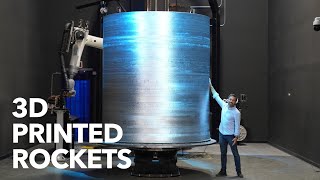
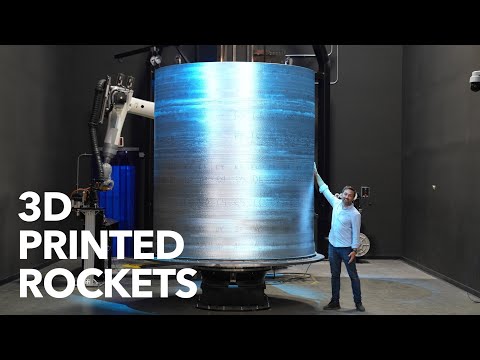
This is the world's largest 3D metal printer.
6 capitulos
- Inside the 3D Metal PrinterThe MachineRelativity Space built the world's largest 3D metal printer with the goal of printing an entire rocket, including fuel tanks and rocket engines, in just 60 days.How It Works• Wire made of aluminum alloy is fed from a spool at 10 inches per second • Lasers and plasma arc discharge work together to melt the wire • The electric waveform changes every couple of milliseconds to control deposition precisely • The process reaches temperatures just above aluminum's melting point of 660°CThe ChallengeEarly attempts resulted in piles of metal that didn't work, requiring years of development to achieve successful results.Real ApplicationThe actual rocket tank structure being printed will launch to orbit by the end of the year, making it the largest 3D printed product of any type ever made that will fly.
- Why 3D Print Rockets?Traditional ApproachBuilding rockets traditionally requires first constructing specialized tools. NASA's Space Launch System required a 170-foot tall Vertical Assembly Center for welding fuel tank components, and took 11 years before the first rocket was assembled.Speed AdvantageRelativity Space, founded just five and a half years ago, plans to launch their first rocket this year using 3D printing instead of traditional manufacturing techniques.Design PhilosophyThe company uses a Silicon Valley approach of building something, figuring out what's wrong with it, and building a better version next, rather than the traditional aerospace approach of extensive upfront planning.Structural Design• Rocket tanks are thinner relative to their diameter than a Coke can • Internal stiffeners prevent buckling and crumpling • 50 PSI of internal pressure maintains structural integrity • Surface roughness adds only 5-10% extra mass and causes no aerodynamic problems
- Advanced Manufacturing SolutionsEngine Components• The injector mixes liquid oxygen and methane propellants into a fine mist • Traditional injectors required over 1,000 individual pieces and took 9 months to build • 3D printed injectors are made as a single piece in 2 weeks at 10 times lower costCooling ChallengesCombustion chambers reach 3,500 Kelvin, hot enough to melt virtually any metal. Cryogenic propellants flowing through cooling channels prevent melting. The Space Shuttle required 1,080 individually welded pipes; 3D printing integrates these channels directly into the design.Material StrengthContrary to common assumptions, 3D printed metals are stronger than traditionally built equivalents because the rapid cooling and solidification process allows for development of custom, stronger alloys.Iteration SpeedSince there is no fixed tooling, design changes are controlled entirely through CAD files. Building a complete engine takes only about one month, allowing rapid version improvements and testing cycles.
- Revolutionary Design PossibilitiesNew Geometries3D printing enables smooth, curvy, bio-inspired designs that are just as easy to print as ordinary structures. The base of Terran R's tank uses shell-like structures that would be impractical with traditional manufacturing.Design OptimizationMany features in Relativity's rockets could not be manufactured using traditional techniques. The optimal structural designs that 3D printing enables look entirely different from conventionally-built rockets.Part ReductionA fully 3D printed rocket has a hundred times fewer parts compared to traditional rockets. The factory has no fixed tooling at all, unlike aerospace factories that have remained largely unchanged for 60 years since Apollo.Production ParadigmTraditional aerospace still builds products one at a time by hand with hundreds of thousands to millions of individual parts. 3D printing represents the first fundamental change to how aerospace factories work.
- Manufacturing Automation RealityAerospace ParadoxDespite assumptions that aerospace is highly automated, it has not adopted automation. Commercial aircraft have several million individual parts, making robot assembly of all components much harder than automobile manufacturing.Production Scale IssueThere is no incentive to automate rocket production because the industry does not produce enough volume. Unlike automobiles made by the hundreds or thousands annually, rockets are built in very small quantities.3D Printing as Automation3D printing solves the automation problem for aerospace uniquely: instead of assembling millions of parts with robots, the printer assembles them in the 3D file itself, then prints them already assembled.Tesla ComparisonThe shift to 3D printing rockets is comparable to the shift from internal combustion engines to electric vehicles. It requires rethinking not just the product design, but the factory, supply chain, and entire company scaling approach.
- Relativity's Vision and FutureMission Goals• Terran One targets low Earth orbit for initial launches • Terran R can send payloads to the Moon and Mars • Long-term vision is to shrink the factory technology and launch it to Mars • Ultimate goal is building an industrial base on MarsMarket OutlookWithin 10-20 years, if rocket flight rates increase significantly, dedicated machines may become cheaper than 3D printing. However, Relativity is well-positioned as world experts in 3D printing rocket hardware regardless of market outcomes.Cost ReductionRelativity's rockets cost about five times less than traditional rockets. With a fully reusable 3D printed rocket, costs could be 10 to 100 times cheaper than current launch services.Broader ImpactMaking space more accessible could fundamentally expand human experience and culture, with potential for Mars-based YouTube channels and long-distance relationships. The existential question drives the vision: what does it mean to be human as we expand beyond Earth?