This is the natural disaster to worry about
What happens if I heat up this rubber band?
17 capitulos
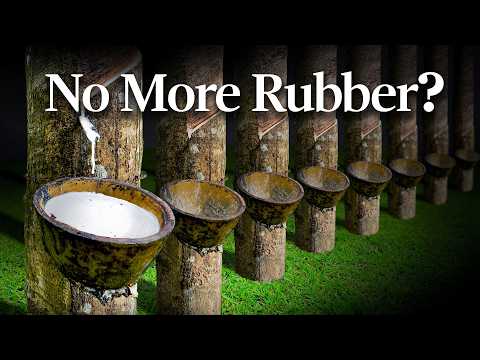
- The Unique Properties of RubberCounterintuitive BehaviorWhen heated, rubber contracts and pulls more strongly, opposite to other materials like glass or plastic which weaken when heated.Remarkable Characteristics• Waterproof and breaks while becoming tougher • Can stretch up to 10 times its length and bounce back • Essential for modern life in tubes, seals, belts, tires, and suspension systemsNatural SourceAll durable rubber comes from the Brazilian rubber tree, a single natural source at risk of being wiped out.Global Dependency RiskLoss of rubber supply could cause complete global societal meltdown and is considered a national security issue.
- The Molecular Structure of RubberDiscovery and ProcessingMesoamericans as early as 1600 BC cut the bark of rubber trees to release latex, a milky white liquid that dries into a stretchy, waterproof solid.Building Blocks• Latex contains isopentenyl pyrophosphate (IPP), the monomer building block of rubber • IPP is found everywhere in nature, including in the human body • Special enzymes build long polymer chains with over 10,000 monomersPolymer StructureRubber polymers contain tens of thousands or hundreds of thousands of carbons, coiled up rather than stretched out end to end.Elasticity Mechanism• Polymer chains are constantly vibrating and bombarded by smaller molecules • When stretched, chains straighten but bombardment keeps them kinked up • Heat increases vibrations, making rubber pull back stronger and shrink
- Why Rubber Can Stretch So MuchMolecular AttachmentMonomers attach on the same side of the double bond (cis-attachment), affecting how the chain folds.Wiggle PatternSingle bonds on carbons rotate to be at angles or in line; bonds with two hydrogens take up space, making at least one bond angle favorable, creating a wiggling ribbon pattern.Stretching ProcessWhen pulled, polymers first line up, then each chain unfolds; the wiggle makes rubber extra stretchy.Natural RecoveryRubber bounces back because complete alignment is rare; the chain returns to a more probable state with wiggles, giving rubber its elasticity.
- Early Rubber Applications and ChallengesAncient UseEarly Mesoamericans mixed latex with juice from tropical morning-glory flowers to form sandals, bottles, and balls.European Discovery• In 1770, English chemist Joseph Priestley used natural latex to erase pencil marks, coining the term rubber • By late 1820s, rubber craze hit the US with demand for Brazilian waterproof boots • Factories like Roxbury India Rubber Company sprang up to make rubber productsCritical ProblemNatural rubber has extreme temperature sensitivity: melts when hot and freezes brittle when cold.Commercial Failure• Roxbury factory faced returns in summer 1834 when waterproof coats stuck to wooden benches on hot days • Warehouse full of rubber products melted and rotted in summer heat, creating a foul-smelling gooey mess
- Charles Goodyear's Vulcanization DiscoveryThe ChallengeCharles Goodyear was tasked with making rubber stable across wider temperature ranges and non-sticky after visiting the Roxbury warehouse full of rotten rubber.Early Experiments• While in debtor's prison, he added compounds to raw rubber with a rolling pin • Discovered magnesia made rubber non-sticky, but stickiness returned over time • Tested mixtures by walking in rubber outfits, ending up in debtor's prison multiple timesBreakthrough MomentIn winter 1839, Goodyear accidentally dropped rubber mixed with sulfur on a hot stove; instead of melting, it charred and hardened.VerificationHis daughter observed him holding the rubber piece near the fire; he nailed it outside in intense cold and found it remained perfectly flexible in the morning.
- Understanding Vulcanization ChemistryProcess MechanismHeat breaks apart sulfur rings into smaller pieces; sulfur atoms grab onto carbon atoms from rubber chains, breaking double bonds and linking chains together.Cross-Link Formation• Sulfur atoms form flexible bridges of one, two, or more atoms in a row between rubber chains • Transforms loose, slippery chains into a flexible but connected network • Prevents melting in heat and freezing in coldProperty ChangesVulcanized rubber becomes stronger, more resistant to temperature changes, and more elastic than raw rubber.Customization• More cross-links make rubber harder for shoe soles and tires • Shorter cross-links resist heat and weathering for seals and insulators • Longer cross-links allow more stretching for medical applications
- Historical Context and Goodyear's LegacyAncient KnowledgeMesoamericans discovered vulcanization thousands of years before Goodyear by mixing morning-glory juice containing sulfur with latex and heating it in the sun.Modern Innovations• Inflatable bicycle tire in 1888 • First rubber medical gloves in 1890 • First car tire in 1895Personal TragedyDespite transforming the rubber industry, Goodyear spent thousands defending patents and died in 1860 at age 59 over $200,000 in debt (equivalent to $7.7 million today).Company LegacyFrank Seiberling founded the Goodyear company in 1938 to honor Goodyear; it now makes $18.9 billion annually and is the third largest tire manufacturer in the world.
- Rubber's Role in Modern TiresTire EvolutionNatural rubber alone wears down quickly, lasting only around 8,000 kilometers; early 1900s saw addition of carbon black for durability.Carbon Black Benefits• Adds color and durability to tires • Conducts electricity, dissipating static charge buildup from driving • Prevents shocking when touching cars and protects against lightning strikesMaterial ProductionOver 70 billion tires have been made since Goodyear's invention; stacked vertically, they could go to the moon and back 21 times.Modern PerformancePassenger car tires now last about 100,000 kilometers due to vulcanization and carbon black additives.
- The Dark History of Rubber ExtractionAmazon MonopolyIn late 19th century, Amazon region supplied over 90% of world rubber; wild rubber trees were separated by hundreds of meters.Human Cost• Rubber barons exploited natives to increase production • Killed roughly 40,000 people in Putumayo region alone • Over 100,000 deaths across wider Amazon region between 1879-1911Colonial ResponseEngland wanted to end Brazil's rubber monopoly, so bio-pirate Henry Wickham smuggled 70,000 rubber seeds to England in 1876.Asian Plantations• British Empire planted seeds in Southeast Asia with similar climate • Created vast plantations of acres of rubber trees • Brazil's rubber share dropped from 80% in 1907 to 1.6% within 30 years
- The Fordlandia DisasterAmbitious ProjectHenry Ford bought 10,000 square kilometers in Brazil in 1928 to build Fordlandia, a utopian American city featuring Cape Cod cottages, hospital, swimming pools, golf course, and fire hydrants.Infrastructure PurposeCould house 10,000 people working to plant millions of rubber trees to ensure Ford's tire supply independent of England's monopoly.The Blight Crisis• Early 1930s: workers noticed black spots on rubber tree leaves • Spots spread within hours to cover entire leaves • Next day, leaves fell off and trees died • Disease spread like a fire front across the plantation dailyRoot Cause• Trees infected by South American leaf blight fungus native to South America • Ford planted 200,000 trees only meters apart, touching roots and branches • Blight spread rapidly through plantation like a plague, destroying 3.6 million trees by early 1940s
- The South American Leaf Blight and Global RiskRelocation FailureFord tried moving project to Belterra downstream, planting another 16,000 acres with rubber trees, but these too all died.Irreversible Problem• To this day, there is no cure for South American leaf blight • Blight is so fatal rubber trees cannot grow in plantations in their native country • South America now makes up less than 2% of global rubber supplyGeographic VulnerabilityOver 90% of rubber comes from Asia; all Southeast Asian rubber trees descended from seeds Wickham stole, making farms essentially one big monoculture.Catastrophic ScenarioIf leaf blight reaches Southeast Asia, global rubber production drops dramatically, causing complete societal meltdown with no trucks, airplanes, or food transport to cities.
- Recent Disease Outbreaks and COVID's Unexpected Role2019 CrisisTwo different diseases jumped from palm trees to rubber trees in Thailand; in six months spread across seven countries and one million acres.Production Impact2020 saw 10% drop in rubber production from disease outbreak.COVID's Surprising EffectCOVID-19 early 2020 stopped spread of these diseases as a byproduct of trying to stop COVID; pandemic prevented further tree destruction.Unanswered QuestionWithout COVID intervention, millions more acres would have been killed or seriously compromised by leaf blights; full extent of potential damage unknown.
- Synthetic Rubber Development and World War IIWar-Time NecessityDuring WWII, Japan cut US off from roughly 97% of world's natural rubber supply; modern war cannot be won without rubber.Massive Investment• US invested approximately $11.1 billion (in today's terms) into synthetic rubber • Equivalent to roughly one-third of Manhattan Project • Complete gamble requiring enormous resourcesRapid SuccessFour major US tire companies developed synthetic rubber called styrene-butadiene in less than three years.Production Shift• 1942: US used 99.6% natural rubber and 0.4% synthetic • 1945: reversed to 14% natural and 86% synthetic • Today: almost 70% of all rubber consumed is synthetic, mostly styrene-butadiene
- Synthetic vs Natural Rubber PropertiesSynthetic Advantages• Made from styrene and butadiene monomers dispersed in water combined into long chains in random arrangement • Doesn't wear down as quickly under friction as natural rubber • Preferred for passenger car tire treads for better abrasion resistanceSynthetic LimitationsSynthetic rubber has much lower tensile strength compared to natural rubber and cannot perform as well in demanding applications.Natural Superiority• Airplane tires are essentially 100% natural rubber • Can withstand extreme temperature changes from -50/-60°C in air to ground landing friction heat • Cannot land safely with synthetic rubber in tires due to its unique crystallization propertiesCrystallization DifferenceNatural rubber crystallizes under stretch, with Van der Waal's forces aligning polymers; synthetic rubber at 98% cis-polyisoprene lacks 1-2% cis percentage needed for crystallization.
- The Latex Allergy Crisis and Nitrile GlovesDemand Explosion• AIDS pandemic and 1987 CDC mandate requiring gloves for procedures increased demand from 300 million to over 36 billion by late 1980s • Dozens of new latex glove factories sprang up to meet demandProtein Exposure• New factories skipped leaching step, leaving soluble proteins in gloves • Nurses and doctors dispersed proteins into air when putting on or taking off unleached powdered gloves • Medical staff breathed in particles throughout shifts into their lungsAllergy Epidemic• Thousands exposed enough to become allergic to latex • Early 1990s: four surgical procedures meant almost certain Type I latex allergy; ten procedures meant definite allergyNitrile Solution• Nitrile rubber gloves developed in late 1980s during AIDS pandemic for those with latex allergy • Blocks harsher chemicals better than natural latex (10-20% permeation vs 80-90% in natural latex) • Medical staff prefer for long surgeries despite nitrile being thicker than natural latex
- Alternative Rubber Sources and Future ProtectionGuayule Plant InitiativeDr. Cornish developed alternative natural rubber from Guayule plant, which lacks proteins causing allergies.Guayule Advantages• Grows in desert climates where rubber tree cannot • Makes stronger, softer rubber than Brazilian rubber tree • Provides hypoallergenic option for medical gloves in long surgeriesStrategic Importance• Scaling Guayule helps address latex allergy problem • Acts as safeguard if South American leaf blight reaches Southeast Asia • Diversifies natural rubber production beyond single monoculture sourceCall to Action• Regulations exist around leaf blight control but flights from Brazil to Southeast Asia possible though difficult • Leaving industry vulnerable to one bad flight is shortsighted • Must not repeat Fordlandia's mistake of ignoring expert knowledge about potential threats
- The Global Rubber DependencyEssential Applications• Transportation, healthcare, construction heavily dependent on natural rubber • A single car contains 250-300 rubber components • Difficult to re-engineer all components from synthetic materialsMilitary SignificanceWithout tires from natural rubber, cannot move military; considered national security issue.Supply Chain Vulnerability• Over 90% of global rubber from Asia, all from clones of original smuggled seeds • Essentially one big monoculture prone to fungal outbreaks • Loss of Asian supply would devastate global productionHistorical LessonHenry Ford's Fordlandia failed because he didn't consult rubber tree experts who could have warned about blight; must learn from mistake and not leave industry vulnerable.