Why People Are So Confident When They're Wrong
Overconfidence gets us into all sorts of trouble.
11 capitulos
- The Barings Bank Collapse: A Trader's Fatal OverconfidenceThe Initial MistakeA junior trader at Singapore's international stock exchange sold 20 futures contracts instead of buying them, costing Barings Bank nearly $40,000. Nick Leeson, her boss, hid the loss in account 88888 to save her job.Growing ConfidenceWhen nobody from Barings noticed the hidden loss, Leeson gained confidence and believed he could win back the loss. This overconfidence led him to make increasingly risky bets to recover the money.Escalating StakesLeeson's staggering overconfidence created a debt of gargantuan proportions. His mistakes would lead to one of the biggest collapses in banking history.Universal ProblemOverconfidence isn't reserved for reckless individuals. It has been implicated in almost every big disaster, from the sinking of the Titanic to the Chernobyl nuclear disaster to the loss of the space shuttle Challenger.
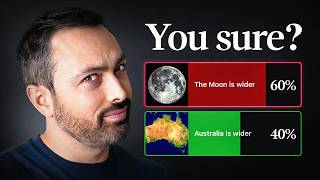
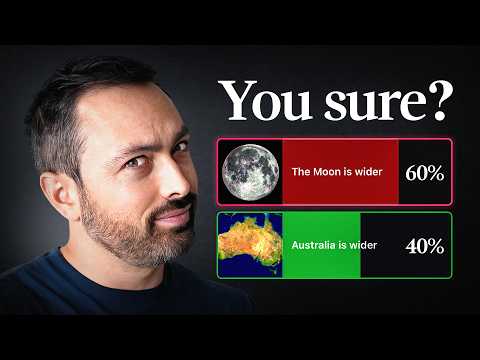
- The Paradox of Confidence: What Research RevealsThe Striking Pattern93% of people think they are better drivers than the median, which is mathematically impossible. This widespread overconfidence affects everyone from ordinary people to experts.The Quiz Results• Researchers tested people with quiz questions asking whether statements like 'Australia is wider than the moon' were true or false • Participants were then asked how confident they were in their answers • When people were 90% certain, they were actually right only 75% of the timeExtreme DiscrepancyThe Veritasium community was asked science questions and asked for confidence levels. Those who were 91-100% sure were correct only 51% of the time.Expert VulnerabilityEven experts are affected. Professional forecasters at corporations and banks predicted inflation with 53% confidence but were right only 23% of the time.
- Understanding Calibration and the Dunning-Kruger MisconceptionWhat is CalibrationCalibration measures how well what you think you know matches with what you actually know. If you're perfectly calibrated and 80% confident, you should be right 80% of the time, but most people are not well calibrated.The Viral GraphThe 'Mount Stupid Curve' is commonly associated with the Dunning-Kruger effect through Google Images, but this graph is actually a meme that doesn't represent the actual research findings.The Real ResearchIn their original research, Dunning and Kruger tested people on grammar, logic, and humor. Those who performed worse had the largest mismatch between confidence and performance, while top performers were slightly underconfident.Statistical ArtifactThe Dunning-Kruger effect may partly be a statistical artifact. When confidence varies over a narrow range while accuracy spans from 0% to 100%, poor performers naturally appear most overconfident and high performers slightly underconfident.
- Information Overload: The Challenger Disaster Case StudyThe Critical WarningOn January 27, 1986, Morton Thiokol engineers saw a weather forecast predicting overnight temperatures would plummet to 25 degrees Fahrenheit. They knew the rubber O-rings in the rocket boosters become less flexible in cold, far below any previous launch temperature.Data Presentation ProblemOver six hours, engineers presented 13 charts with scattered, incomplete data on O-ring temperature, hot gas erosion, joint rotation, and more. No single chart told the whole story, and the data was not synthesized into a clear narrative.Management DecisionOverwhelmed by seemingly contradictory data and confident their rocket boosters were safe, Thiokol management overruled their own engineers and approved the launch.Tragic OutcomeAt 11:38 AM on January 28, 73 seconds after launch, the Challenger exploded, killing all seven crew members. The O-ring failure in cold temperatures was the direct cause.
- Why Our Brains Struggle: Memory and Mental ShortcutsMemory LimitsAssessing your own accuracy is a mentally taxing task. Studies by Hansson, Juslin, and Windmann found that people with worse short-term memory were more often wrong and more likely to be overconfident.Working Memory LoadResearch by Conte in 2023 showed that as memory load increased, confidence estimates became less accurate, even for participants with higher working memory capacities.Mental ShortcutsOur brains use heuristics—mental shortcuts—that create systemic errors called cognitive biases. One shortcut is substituting hard questions with easier related ones.Substitution Effect ExampleWhen students were asked about happiness in their life without priming, responses didn't correlate with dating frequency. But when asked about dates first, the correlation jumped to 0.66, showing people substituted the hard question with an easier one.
- The Evolutionary Advantage of OverconfidenceStatus and LeadershipIn a scientific version of 'The Apprentice,' researchers found that overconfident individuals were more likely to lead, assert themselves, and maintain influence, even when their actual abilities were mediocre.Brain Response to ConfidenceUsing fMRI, researchers at the University of Sussex measured brain activity after people heard confident versus unconfident advice. Those who heard confident advice showed increased activity in the ventromedial prefrontal cortex, a region associated with processing rewards and satisfaction.Biological TuningHuman brains are biologically tuned to be influenced by confident individuals. We literally feel better when we hear confident people speak.Incentive to ExaggeratePeople who express more confidence in job interviews or political campaigns earn the confidence of interviewers and voters, even if they're overconfident and can't actually deliver on their assertions.
- Leeson's Escalation: The Power of Unreliable FeedbackPublic Success FacadeWhile secretly racking up huge losses in account 88888, Leeson was publicly posting huge profits. Management believed the illusion and granted his requests for huge sums, up to $5 million at a time.Mounting Hidden LossesBy Autumn 1994, the account was nearly $260 million in the red. To mask this, Leeson began buying futures from himself, inflating his perceived profits further.Unshakeable Management FaithAt SIMEX's 10th anniversary in September, Barings received awards largely credited to Leeson. Some traders raised doubts about such high profits from low-risk trading, but management's faith was unshakeable and they dismissed concerns.Feedback ProblemLeeson's overconfidence was amplified by the complexity and unpredictability of the market. He had won back losses before, which significantly clouded his judgment and reinforced his overconfidence with unreliable feedback.
- Clear Feedback vs. Noisy EnvironmentsControlled EnvironmentsIn controlled environments with clear rules and guaranteed outcomes, like chess, there is clear feedback on whether decisions are good or bad. Professional chess players learn to make better decisions with more accurate confidence.Noisy EnvironmentsIn noisy environments where there is rarely consistent or timely consequences for predictions, feedback is unreliable. Whether confidence is accurate or misplaced is increasingly hard to judge, even amongst experts.Political PredictionsPolitical pundits frequently suffer from overconfidence due to unclear feedback. Before 2024, analyst Allan Lichtman had accurately predicted the winner of nine of ten previous US presidential elections, but his 2024 prediction of a Kamala Harris victory proved wrong.Election FactorsLichtman attributed his 2024 miscalculation to the spread of disinformation that misled the electorate. The noisy environment made it difficult to discern key issues like the actual state of the economy.
- The Cataclysm: Earthquake and CollapseMassive PositionsBy 1995, Leeson's losses were in the hundreds of millions, and Barings had unknowingly sent him $1 billion. Leeson estimates he was probably half of the entire Nikkei futures market.Natural DisasterOn January 17, 1995, the Great Hanshin Earthquake struck Japan 20 kilometers from the city of Kobe with a magnitude of 6.9, devastating the city which was one of Japan's key ports.Market ImpactThe earthquake devastation spread to the stock market. The Nikkei index plunged 1055 points. Leeson, attempting to double down again, bet heavily that the Nikkei would make a rapid recovery.Final OutcomeThe market didn't recover as Leeson expected. In total, he had lost $2.8 billion in today's money. On February 23, Leeson went on the run, and three days later, Barings, one of the oldest and most trusted banks in the world, collapsed.
- Solutions: Calibration, Humility, and Collective WisdomTracking PerformanceTo calibrate confidence judgments, keep track and keep score. Instead of promising results by a specific date, express uncertainty with probabilities, like 'I think there's a 60% chance I can get you comments by Friday.'Intellectual HumilityBeing intellectually humble is a medicine for overconfidence. The best calibrated people aren't those who know the most, but those who know what they don't know.Feedback and Wisdom• Practicing awareness of calibration helps improve accuracy • Capitalizing on the wisdom of the crowd by listening to others improves decisions • Listening to people who disagree with you and understanding their arguments is especially helpfulTrue WisdomTrue wisdom lies not in being certain, but in knowing the limits of your own certainty. Understanding what information those who disagree with you have that you lack is very helpful for making better decisions.
- Elements of Truth: A New Board Game ProjectGame ConceptElements of Truth is a new board game containing over 800 fascinating science trivia questions. The number of points you win depends on how confident you are in your answer.Gameplay Mechanics• You can bid any number from 1 to 10 on each question • If unsure, you can play a low number • You can follow the lead of someone else who you think should know the answerTesting ResultsThe game has been tested with scientists, teachers, and students. It regularly leads to discussions that go way beyond the initial questions.Content and LaunchThe core game comes with 200 questions covering all aspects of science, and five additional packs on specific topics like physics, technology, engineering, and astronomy. The game is launching through Kickstarter with a special community pack where viewers can submit questions.