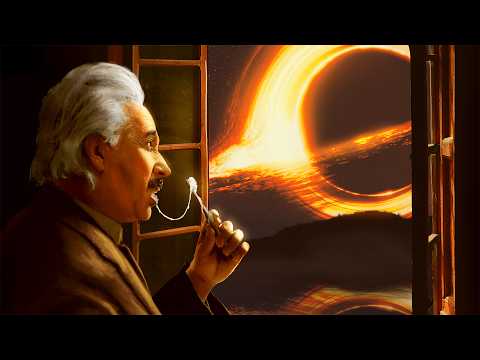
Something Strange Happens When You Follow Einstein's Math
You can never see anything enter a black hole.
17 capitulos
- The Paradox of Falling Into Black HolesObservable EffectAn outside observer never sees objects enter a black hole. Instead, the rocket and astronaut appear to slow down, freeze in time at the event horizon, and fade from view as light becomes increasingly redshifted.Time DilationFrom the observer's perspective, the falling astronaut's time slows down dramatically. His movements and fist-shaking appear to slow and eventually stop at the moment he crosses the event horizon.Light BehaviorLight from the spaceship gets dimmer and redder until it completely fades. If you could see the redshifted light, you'd theoretically see everything that has ever fallen into the black hole frozen on its horizon.Key LimitationPhotons are emitted at discrete intervals, so a last photon exists outside the horizon. These images fade after time rather than remaining visible forever.
- Einstein's Revolution in Understanding GravityNewton's ProblemNewton's theory couldn't explain how masses separated by vast distances could exert force on each other through empty space. Newton himself found this concept absurd and deeply troubling.Einstein's SolutionEinstein proposed that masses don't exert forces directly on each other. Instead, mass curves spacetime in its vicinity, which then curves spacetime around it, affecting how objects move without requiring action at a distance.Field Equations• Einstein's field equations describe how matter and energy distribution determines spacetime curvature • The equations are actually a family of coupled differential equations, not just one simple equation • Solving them requires integration and complex mathematical proceduresPhysical MechanismEarth orbits the sun because the spacetime it passes through is curved by the sun's mass. Masses are affected by local spacetime curvature rather than by direct forces.
- Light Cones and Spacetime DiagramsFuture Light ConeRepresents all possible futures reachable from your current position. Defined by a light flash spreading in all directions, limiting where you can travel since nothing can exceed light speed.Past Light ConeRepresents all events that could have influenced you up to the present moment. Formed by photons from all corners of the universe converging at your current location.Spacetime IntervalIn flat spacetime, the interval formula uses minus dt squared plus dx squared. Around a mass, spacetime curvature requires modifying this equation to account for curved geometry.Diagram RepresentationShows one spatial dimension and one time dimension. Light rays travel at 45 degrees by convention, making it easy to visualize what regions are causally connected.
- Schwarzschild's Historic SolutionDiscovery ContextKarl Schwarzschild, a German astrophysicist, found the first non-trivial solution to Einstein's equations in 1915 while calculating artillery trajectories during World War I. He did this work on the eastern front between Russia and Germany.Assumptions Made• Imagined the simplest possible scenario: an eternal static universe • Considered only a single spherically symmetric point mass • Mass was electrically neutral and not rotating • Used spherical coordinates centered on the massSolution PropertiesThe Schwarzschild metric describes how spacetime curves outside the mass. Far away, spacetime is nearly flat, but closer to the mass, it becomes increasingly curved, attracting objects inward and slowing time.Einstein's ReactionEinstein expressed amazement that an exact solution could be formulated so simply. He praised Schwarzschild's elegant work, calling it a remarkable achievement.
- The Problem of SingularitiesCentral SingularityAt r equals zero, the center of mass, a term in the Schwarzschild metric blows up to infinity. This mathematical breakdown suggests the equation can no longer describe physical reality at this point.Event Horizon SingularityAt the Schwarzschild radius (a special distance from center), another term blows up to infinity. This creates a second singularity outside the central mass, puzzling physicists about its meaning.Escape Velocity InsightAt the Schwarzschild radius, the escape velocity equals the speed of light. This means nothing, not even light, can escape from inside this radius, creating a black hole.Scientific SkepticismMost scientists doubted black holes could exist because they would require enormous mass compressed into tiny space. The physical mechanism for such compression seemed implausible.
- Stellar Collapse and Degeneracy PressureStar Life CycleDuring a star's life, gravity pulling inward is balanced by radiation pressure from nuclear fusion. When fuel runs out, radiation pressure drops and gravity dominates, pulling material inward.Electron Degeneracy• Pauli's exclusion principle prevents electrons from occupying the same quantum state • As matter compresses, electrons occupy tiny volumes with increased uncertainty in momentum • This creates outward pressure that can support white dwarf stars • Sirius B was an observed example of such a starChandrasekhar's Discovery19-year-old Subrahmanyan Chandrasekhar realized electron degeneracy pressure has limits. Electrons can only move up to light speed, meaning degeneracy pressure can only support stars up to a certain mass threshold.Eddington's OppositionRenowned scientist Arthur Eddington publicly rejected Chandrasekhar's findings, claiming nature would prevent stars from behaving so absurdly. This resistance delayed acceptance of stellar collapse possibilities.
- Neutron Stars and the Path to Black HolesNeutron FormationWhen stars collapse beyond white dwarf density, electrons and protons fuse to form neutrons and neutrinos. Neutrons are fermions with nearly 2000 times the mass of electrons.Neutron DegeneracyNeutrons possess even stronger degeneracy pressure than electrons due to their greater mass. This neutron degeneracy pressure can support much more massive stars than electron degeneracy can.Maximum Mass LimitsJay Robert Oppenheimer and George Volkoff discovered neutron stars also have maximum mass. Beyond this limit, nothing can prevent complete gravitational collapse into a black hole.Collapse InevitabilityOppenheimer and Hartland Snyder showed that for the heaviest stars, collapse continues indefinitely when fuel runs out. This demonstrated that black hole formation was physically inevitable for sufficiently massive objects.
- The Event Horizon ParadoxEinstein's ConcernEinstein couldn't accept that black holes could form because mathematics showed time freezes at the event horizon. If nothing could cross the horizon, he questioned how black holes could even form.Oppenheimer's ResolutionOppenheimer proposed that outside observers never see objects enter the black hole, but someone falling through wouldn't notice anything unusual. They would cross the event horizon without realizing it and continue toward the singularity.Coordinate System IssueThe singularity at the event horizon resulted from a poor choice of coordinate system. Using different coordinates makes the singularity disappear and allows objects to cross the horizon.Space as WaterfallSpace can be visualized as flowing toward the black hole like a waterfall. Near the horizon, photons must swim against this flow, taking longer and longer to escape.
- Spacetime Mapping and Visualization TechniquesMap Projection Analogy• Spacetime diagrams are 2D projections of 4D curved spacetime, similar to projecting 3D Earth onto a 2D map • Different map projections preserve different properties (angles, sizes, shapes) • Mercator projection preserves angles but misrepresents sizes • Gall-Peters projection preserves sizes but distorts angles and shapesCoordinate TransformationChoosing different coordinate systems reveals different aspects of physical reality. The singularity at the event horizon appears in some coordinate systems but vanishes in others that show objects can cross.Kruskal-Szekeres DiagramThis map represents the black hole interior and nearby spacetime. It transforms the singularity from a spatial point into a temporal line, showing the singularity is not a place in space but a moment in time.Penrose DiagramCompresses the infinite universe, past, distance, and future into a single map using a fish-eye lens effect. Light rays always travel at 45 degrees, and the black hole singularity becomes a straight line at the top representing a final moment in time.
- White Holes and Parallel UniversesWhite Hole DefinitionWhite holes are the time-reverse of black holes in which things are expelled outward rather than pulled inward. They have the opposite property: if you're inside the event horizon, you must be ejected outward.Time Symmetry• Relativity doesn't specify which direction time flows • Any solution to Einstein's equations can be time-reversed mathematically • A time-reversed black hole solution is also valid • This mathematical symmetry doesn't necessarily mean both types exist in natureParallel UniversesThe maximally extended Schwarzschild solution reveals two universes. If objects are ejected from the white hole to the left, they enter a completely separate universe parallel to our own.Universe ConnectionPeople falling into a black hole from one universe and people falling into it from a parallel universe would meet in the same black hole. However, both would eventually reach the singularity.
- Einstein-Rosen Bridges and WormholesBridge StructureAn Einstein-Rosen bridge is a feature in the maximally extended Schwarzschild solution where the event horizon connects both universes. Lines of constant Kruskal time connect the spaces of both universes.Visual AppearanceAs you approach the event horizon, spacetime curves more and more. At the event horizon crossing point, you can traverse into the parallel universe, creating a wormhole-like passage.Traversability ProblemThese wormholes are unstable in time. Like a bridge that becomes shorter and longer repeatedly, the pinching-off happens too fast for anything with finite speed to traverse it.Light Cone BarrierLooking at the Penrose diagram, when you're inside one universe, light cones cannot reach the other universe. The only way to cross would require traveling faster than light, which is impossible.
- Rotating Black Holes and the Kerr SolutionPhysical NecessityEvery star rotates, and angular momentum must be conserved. Therefore, every black hole in nature must also be rotating, making Schwarzschild's non-rotating solution unrealistic.Mathematical Discovery• Physicists struggled for 40 years to solve Einstein's equations for spinning mass • Roy Kerr found the solution in 1963, which is far more complicated than Schwarzschild's • The solution is not spherically symmetric but symmetric only about the spin axis • The black hole bulges around the equator due to rotationMulti-Layer StructureRotating black holes consist of several layers rather than a simple sphere. The structure includes the ergosphere (where space rotates faster than light speed), the outer event horizon, the inner event horizon, and a ring singularity.Ergosphere PropertiesIn the ergosphere, space gets dragged around faster and faster. No matter how hard you fire rockets, you cannot stay still relative to distant stars, but you can still escape the black hole.
- Interior Regions and Ring SingularityOuter HorizonThe outer horizon represents the point of no return in a rotating black hole. Once crossed, you can only move inward, but you're not immediately doomed to the singularity.Inner Region FreedomInside the inner event horizon, you can move around freely and are not forced directly toward the singularity. This contrasts sharply with non-rotating black holes where immediate doom is certain.Ring SingularityIn rotating black holes, the singularity expands from a point into a ring. You can potentially fly through the center of the ring rather than being crushed by it.Penrose Diagram ChangesThe singularity line lifts up and moves to the sides in the Penrose diagram. This reveals a new region inside the inner horizon where you can move freely.
- Traversing to Other UniversesWhite Hole ExitInside the inner region of a rotating black hole, edges aren't at infinity or a singularity, meaning something lies beyond them. Venturing further could lead to a white hole that ejects you into another universe.Theoretical Journey• Fall into a rotating black hole in one universe • Fly through the ring singularity • Exit through a white hole into a new universe • Continue this pattern through infinite universesSingularity PassageRather than time ending at the singularity, you find yourself in a strange universe with inverted gravity. This is an anti-verse where gravity pushes instead of pulls.Return OptionYou can jump back across the singularity to escape the anti-verse and return to a universe with normal gravity. The mathematics allows traversing between these exotic regions.
- Limitations of Theoretical SolutionsEternal Black HolesBoth extended Schwarzschild and Kerr solutions describe eternal black holes in empty universes with no formation mechanism. They stretch infinitely into past and future rather than showing how black holes actually form.White Hole Non-existenceWhite holes are rarely realized in the universe compared to black holes. The lack of a formation mechanism makes white holes physically unrealistic despite being mathematically valid.Energy Accumulation ProblemIn maximally extended Kerr solutions, infinite time compresses into the top corner where light can accumulate. This creates infinite energy flux along the inner horizon, which forms a new singularity.Sealing EffectThe energy-created singularity seals off the ring singularity and beyond. This eliminates the possibility of traversing to other universes, white holes, and parallel universes in realistic black holes.
- Exotic Matter and Traversable WormholesMorris-Thorne WormholesIn 1987, Michael Morris and Kip Thorne explored wormholes that advanced civilizations could use for travel. These have no horizons, are stable in time, and could theoretically be constructed.Viable Geometries• Several geometries allowed by general relativity could connect different universe parts • Could create interstellar highways between distant locations • Might even connect to different universes • All require exotic matter to remain stableExotic Matter RequirementAll traversable wormhole geometries require exotic matter with negative energy density. This would prevent the wormhole from collapsing on itself during passage.Practical ImpossibilityWhile mathematically possible in relativity, exotic matter is not believed to exist. Using realistic matter properties described by Einstein's field equations, traversable wormholes are not actually possible.
- Summary and Future PossibilitiesCurrent UnderstandingOur best current understanding suggests that white holes, traversable wormholes, and parallel universes likely don't exist. Black holes appear to be real, but the exotic structures found in idealized solutions don't materialize in actual physics.Historical ReversalsScientists once believed black holes were impossible, yet observational evidence now confirms they exist. This history suggests confidence should be tempered, as discoveries might surprise us again.Remaining MysteriesDespite decades of study, questions remain about black hole physics. The relationship between quantum mechanics and general relativity near singularities remains unresolved.Open QuestionsIf one universe can exist, why not two or more? The mathematical foundations of relativity allow possibilities that observation hasn't yet definitively ruled out, leaving room for future discoveries.