L’aéroport de Berlin-Tempelhof | ARTE
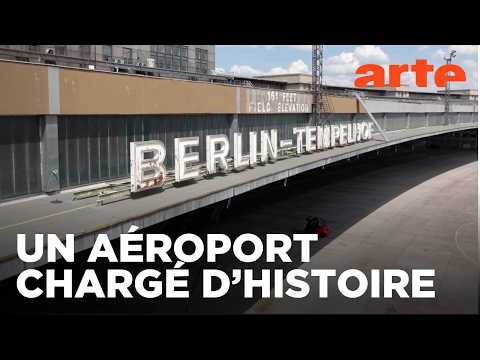
L'aéroport de Berlin Temple Hof, un complexe monumental, l'un des grands projets de construction d'Hitler.
17 chapitres
- Berlin-Tempelhof: A Monument to HistoryHistorical SignificanceBerlin-Tempelhof was a monumental airport complex and one of Hitler's major construction projects, representing the regime's ambitions to transform Berlin into Germania, the world capital.Personal Memories• Residents vividly remember aircraft passing over buildings during the Cold War period • The airport represents a unique space filled with historical weight and meaning for Berlin's populationOperational TimelineThe airport ceased its commercial activity definitively in 2008 after serving Berlin for decades.Legacy and TransformationTempelhof evolved from a symbol of Nazi power to a place of freedom during the Berlin Airlift, and eventually became an irreplaceable public space unlike anywhere else in the world.
- Tempelhof as a Public Leisure SpaceRecreation and Sports• The former airport's 300 hectares of open space became ideal for roller skating and jam skating • Families, sportspeople, and friends gather on the historic runways for various leisure activitiesPhysical CharacteristicsThe smooth runway surface is exceptionally pleasant for skating, with long and wide expanses that provide an unobstructed view and excellent air circulation, unlike crowded city parks surrounded by buildings.Community RevivalJam skating experienced a renaissance following the Covid-19 crisis, with passionate practitioners finding the location uniquely suited to their sport.Sense of FreedomUsers describe the space as providing an immense sensation of liberty and openness, with one skater comparing the feeling to having wings and becoming a superhero when executing tricks.
- The Hijacking of August 30, 1978The Flight PlanA Polish LOT airline flight departed from Gdansk carrying approximately 50 East German citizens, including a family heading home to East Germany after vacation with two small children.The Diversion• At 10:04 AM, the aircraft was hijacked by a single man named Detlef Jed armed with a fake pistol • The plane was diverted to Tempelhof in West Berlin instead of landing at the intended Schönefeld airport in East GermanyPassenger ChoicesThe hijacker informed passengers they could now disembark. While all passengers initially left the aircraft, the majority of German travelers chose to return to East Germany despite the opportunity to flee.Family DecisionConstance Glin and her family decided to stay in the West after realizing the opportunity for freedom, despite her initial hesitation and the difficulty of leaving behind family, friends, and possessions in East Germany.
- Architectural Ambition Under Nazi RuleDesign and MegalomaniaArchitect Ernst Sagebiel was tasked in 1935 to completely redesign the airport to become a world-class facility as part of Hitler's plan to make Berlin the capital of the world.Architectural Features• The main building formed a circular arc of 1,200 meters with a surface area of 300,000 square meters • Hitler ordered the construction of grandstands on the roof with initial capacity for 100,000 spectators • A further embankment was planned to accommodate one million additional spectatorsConstruction ChallengesConstruction began in 1936 but was delayed and eventually halted by World War II, leaving many architectural elements incomplete, including unresolved lighting systems and unfinished entrance halls.Wartime RepurposingDuring World War II, forced laborers were transferred to the main hall to assemble fighter aircraft wings, with the production line running through the center of the building while components were stored on the sides.
- Bombing and Survival During World War IIThe Bombing Campaign• Allied bombers conducted raids over the airport, first dropping illumination bombs called Christmas trees to light targets for subsequent bombers • Young residents watched the bombing spectacle from windows and balconies, fascinated by the aerial displayBuilding ResilienceDespite intensive bombing campaigns in the surrounding area, the massive Tempelhof building was never seriously damaged, as bombs systematically fell on surrounding residential areas instead of the airport complex.War's EndBy 1945, wreckage of German aircraft littered the runways, testifying to the Nazi defeat as Hitler's armies capitulated.Allied Occupation• Soviet forces occupied the airport first • American forces arrived in Berlin in July 1945 • Berlin was divided into four occupied sectors among the Allies
- The Berlin Airlift and FreedomThe Blockade CrisisIn June 1948, Soviet forces closed all land access to West Berlin in response to Western monetary reforms, creating the Berlin Blockade, a major Cold War episode.The Airlift Response• Americans and British launched an immediate response with no intention of losing control of West Berlin • For one year, allied aircraft delivered 1.5 million tons of coal, 500,000 tons of food, and essential supplies to the besieged cityDaily Life ImpactAn allied aircraft landed every two to three minutes, creating an incessant aerial shuttle that became a genuine popular attraction and symbol of hope for survival.Children's Joy• Pilots dropped small parachutes with candy and chewing gum to Berlin's children • US Air Force pilot Gale Alvorsen initiated the candy drops, becoming known as the Candy Bomber • Young Berlin residents, including Vera Mitri, eagerly collected the gifts from the sky
- Postwar Revival and Golden AgeCommercial ResumptionIn the early 1950s, civil aviation resumed at Tempelhof, initially operated by foreign carriers including Panam, Air France, and British European Airways as West German pilots were not yet authorized to serve Berlin.Travel as Luxury• In the 1950s, flying was an exceptional luxury rather than routine travel • Even in the 1970s, observers outnumbered actual passengers at the airport • Terminals featured restaurants, shops, and postal services for travelers and visitorsRapid GrowthTempelhof quickly became one of Europe's most frequented airports, welcoming its three millionth passenger on December 6, 1955.Isolation FactorThe dramatic increase in passengers was driven by West Berlin's enclave status, surrounded by East Germany, making air travel the safest and most practical option for residents unable to cross the heavily monitored border.
- Constance's Journey: East to WestThe Crisis MomentAfter the hijacking, Constance faced an impossible choice: follow her husband to uncertain freedom in the West or return to East Germany, abandoning family and security.East German Life• Constance worked as a nurse and had stable employment • She received regular packages from relatives in the West • She lived in separate apartments from her husband, indicating marital strainThe DecisionFellow passengers convinced her to stay with her family in the West, emphasizing that such an opportunity would never come again, despite her hesitation about leaving behind everything familiar.No ReturnOnce she disembarked, all backward movement became impossible as passengers who wished to return were bused back to Schönefeld airport and interrogated for hours by the Stasi secret police.
- Adjusting to Western LifeInitial Culture Shock• Constance was overwhelmed by permanently illuminated stores overflowing with merchandise • She struggled with the freedom to choose clothing, unable to make decisions that depleted her mentally • She felt perpetually displaced and was perceived as a refugee by localsSpousal RolesHer husband took responsibility for selecting her clothes, a dynamic that suited her initially and continued for years, reflecting the dependence she developed on his guidance.Gender and Economic Reality• In East Germany, employment was mandatory and all citizens had independent incomes • In West Germany, Constance became a housewife for 21 years while maintaining her husband's accounting • She was entirely dependent financially on her spouse during this periodSystemic DifferencesEast German regime required initiative and opinion-giving was difficult, while basic necessities, housing, and goods were heavily subsidized, creating a fundamentally different economic and social foundation.
- Children's Bridge AirliftRefugee Children ProgramTo help thousands of East German refugee children escape difficult conditions in West Berlin, the Allies created a new airlift transporting children from Tempelhof to West Germany.Host FamiliesGerman children were received by American military families stationed in bases like Ramstein in western Germany, providing six weeks of vacation experiences.Transformative Experiences• Harry made the journey in 1955 and experienced luxuries impossible in Berlin: the Berlin circus Busch, magnificent forests, a car, ice cream, and kindness from his host family • 10,000 children participated in the program between 1953 and 1957Emotional ImpactUpon return to Tempelhof, Harry's mother failed to recognize him at first due to his American haircut and new leather clothes, illustrating how much he had changed during his transformative vacation.
- Hollywood Glamour at TempelhofCelebrity Arrivals• Tempelhof became the arrival point for international film stars including Gary Cooper, Jean Kelly, Rita Hayworth, and Jane Mansfield • German stars such as Marlon Brando, Till Liselotte Pulver, and Magnani also used the airportBerlin Film FestivalOnce yearly, the city transformed into 'Little Hollywood' during the Berlinale film festival, created in 1951, bringing international cinema glamour to the German capital.Press AccessJournalists like Alexander Coolpock had direct press credentials allowing access to arriving planes, enabling intimate interviews with major film and political figures before departure.Political Figures• Federal Chancellor Konrad Adenauer visited Tempelhof • President Theodor Heuss arrived at the airport • President Nixon and Willy Brandt, later Chancellor, passed through the terminal
- American Military Presence and CommunityMilitary InfrastructureThe US Air Force transformed part of Tempelhof into a practical barracks housing up to 1,000 soldiers, complete with cooling and air conditioning systems maintained by technical sergeants.Recreation Facilities• Soldiers enjoyed racquetball courts, rugby fields, basketball courts, saunas, and restaurants • The complex featured a post office, chapel, whiskey and clothing shops, and hi-fi equipment stores • The Silver Wings Club discothèque served as a major social venue for military personnelMilitary-Civilian Integration• Ralph Van Dervist served as an Air Force sergeant from 1969 to 1976 • He married a German woman, Marau, celebrating their 1971 wedding reception at the Silver Wings Club • Annual open house events allowed Berliners to experience the military baseCommunity ServiceMilitary personnel organized hamburger and ice cream stands, with troops being requisitioned for grilling duties during public open house celebrations.
- Bertram's Liberation and SuccessPsychological FreedomBertram described his escape from East Germany as removing an armored weight from his chest, enabling him to breathe freely and access possibilities he never dared dream about in the socialist system.Economic Opportunity• He successfully adapted to the Western system, building a house with his wife's help • He established his own business as a computer developer • He traveled extensively internationally for workFamily ImpactThe family traveled significantly, creating opportunities for their children that would have been impossible in East Germany.Personal FulfillmentBertram celebrated the August 30 hijacking anniversary as a second birthday, viewing the decision to leave as correct and life-changing for the entire family.
- Decline and Closure of the AirportFinal Decline• With the opening of Berlin Tegel Airport in 1974, Tempelhof's passenger traffic declined yearly • By 2008, the airport had become financially deficitiary despite its iconic status • The US military base closed in 1993, ending decades of American presenceLast Flight• The final commercial flight departed on October 30, 2008, a route to Mannheim with only 31 passengers • The flight was delayed 30 minutes before departure • Passengers specifically chose this final flight to witness the airport's operational closurePassenger NostalgiaTravelers experienced rapid and seamless processing: passengers could register, pass through control, and board within minutes, walking directly onto the tarmac to board aircraft waiting outside hangars.Irreplaceable LocationTempelhof was unique as an urban airport accessible by metro in a world capital where major cities like New York, Paris, and London would dream of maintaining such convenient infrastructure.
- Tempelhof as Public Park and Community SpacePark TransformationFollowing uncertain future prospects regarding real estate development, the Berlin municipality decided to convert the massive terrain into a public park, officially inaugurated on May 8, 2010.Photographic Legacy• Photographer Anna Tìl discovered the site soon after opening and committed to a decade-long documentation project • She completed 40 photographic sessions capturing the evolution of markings, weathering, and artistic aesthetic of the runway surface • Ground markings eroded over time but displayed beautiful modern artistic qualitiesCommunity Function• Thousands of people visit daily for sports, sunbathing, and shade • Community gardens provide space for residents without yard access • Tempelhof serves as essential vacation destination for people from difficult neighborhoods unable to afford vacationsSocial ValueFor disadvantaged communities lacking garden access or vacation resources, Tempelhof provides precious refuge and fulfills crucial social function as communal meeting space.
- Constance's Later Life and ReflectionEntrepreneurial Achievement• More than 20 years after leaving East Germany, Constance finally appreciated Western advantages • After divorcing in 2007, she founded a home care business in Mannheim • She successfully operated the company for 10 years before selling it advantageously and retiring comfortablyPersonal Transformation• Her husband Bertram remarried • Constance remarried in 2012 and enjoys retirement while caring for grandchildren • She possesses financial security and peace of mind from her business successTemporal SignificanceThe airport ceased operations 30 years after the hijacking that fundamentally changed her life, marking the passage of generations and historical cycles.Space of FreedomConstance transformed her perception of Tempelhof from a place of anxiety and insecurity into a symbol of freedom, reflecting how the location enabled her unexpected liberation from an authoritarian regime.
- Preservation and LegacyBuilding Redevelopment• The main building is occupied by businesses, foundations, and the Berlin police department • The structure remains visible as reminder of architectural ambition and historical weight • The building represents both Nazi megalomania and eventual repurposing for democratic purposesDevelopment TensionsBerlin's chronic housing shortage regularly resurrects proposals for real estate development on the terrain, creating ongoing conflict between residential needs and preservation of public space.Historical Meaning• Tempelhof remains charged with history representing Nazi ambition, Cold War survival, democratic freedom, and human resilience • The site embodies multiple historical narratives including persecution, escape, liberation, and community buildingEnduring SymbolFor individuals like Constance, Tempelhof represents the location where life's trajectory fundamentally changed, transforming a place once associated with fear and authoritarian power into a lasting symbol of freedom and possibility.