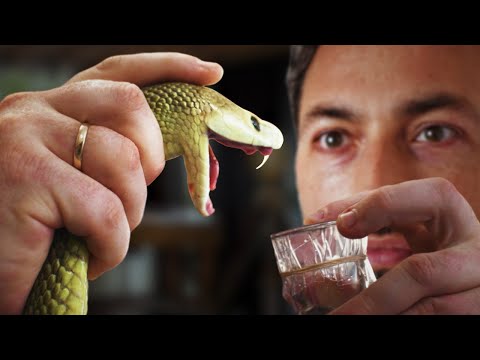
How Horses Save Humans From Snakebites
8 chapitres
- Inside the Australian Reptile Park's Venom Collection RoomSetting and PurposeDerek visits the Australian Reptile Park where they milk snakes and spiders to extract venom for making antivenom that saves lives.Danger and Safety• The room contains venomous snakes floor to ceiling, kept only by small locks and thin glass • A snake struck the glass hard enough to scare a child after being tapped on by a visitor • In Australia, 1-3 people die annually from snake bites; internationally, the WHO estimates 120,000 deathsLocal ResourcesAustralia has some of the best antivenom products on the planet and a federally funded antivenom program that provides free antivenom to anyone regardless of background.Demonstration BeginsStaff prepare to milk a large coastal taipan using minimal equipment, positioning it to bite into a vial to collect venom.
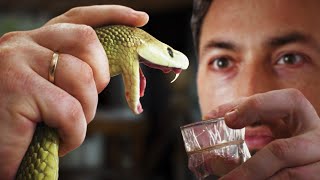
- Venom Milking Procedure with Coastal TaipanCollection Process• The snake is pinned and positioned to bite into a vial • A large amount of venom is delivered very quickly in the bite • After biting, the venom glands are massaged to extract additional drops • Every drop of venom matters for antivenom productionProduction RequirementsApproximately 15 snakes are needed to produce one vial of antivenom.Handler SafetyWhen returning the snake to its enclosure, it becomes a race between the handler and the snake, making this the most dangerous part of the procedure.Venom PowerThe coastal taipan is one of the most toxic snakes on the planet, and specimens at the park are selectively bred to produce five to seven times more venom than wild counterparts.
- Snake Venom Evolution and Fang StructureVenom OriginsVenom evolved from saliva and is used primarily for catching and digesting prey, with each snake species having different venom tailored to their specific prey.Fang Development• Almost 2/3 of all snakes are rear-fanged because the venom gland is located behind the eye, making the shortest duct path downward to the back of the top jaw • Evolutionary pressures moved fangs closer to the front of the jaw to improve hunting ability • Fangs evolved from smooth teeth with venom flowing on the outside to grooved fangs to hollow injection fangsHollow Fang DistributionOnly 1/7 of the world's snakes have hollow fangs, but almost all venomous snakes in Australia do have hollow fangs.Venom Injection PowerMacro photography reveals that snakes with hollow fangs deliver venom like jets, injecting it directly into prey with tremendous force.
- Selective Breeding and Inland Taipan MilkingBreeding Program• The reptile park selectively breeds snakes for antivenom production, specifically choosing the most aggressive individuals • Coastal taipans are bred to produce five, six, or nearly seven times more venom than wild counterparts • The breeding approach is: find the two most psychotic snakes, put them together, and hope the worst comes outWorld's Most Toxic SnakeThe inland taipan (fierce snake) is the most toxic land snake on the planet, with one drop of venom capable of knocking over 100 adult humans.Venom Potency• A bite from a King Cobra contains enough venom to kill 13,000 mice (estimated to kill around 4 humans) • The inland taipan bite contains enough venom to kill 500,000 mice (more than 100 humans) • Some snakes at the park produce 4.5 to 4.9 grams of venom per biteHandler ExperienceWhen milking the inland taipan, the handler is very quick and very quick, making handlers nervous every time; the handler emphasizes that the moment they stop getting nervous is when they should quit.
- Venom Toxicity Mechanisms and Handler SafetyToxicity Complexity• The concept of the most venomous snake is complicated because venom evolved for potency against specific prey • Prey species evolved resistance to venom, so lethality depends on the snake, the bitten animal, and venom amount injected • Snake venom is lethal to humans because we are closely related to snakes' main prey: rodents split from primates only 75 million years agoFour Killing Methods• Neurotoxic: damages nervous system by interfering with neurotransmitters • Hemotoxic: thins blood, prevents wound healing, causes internal bleeding • Cytotoxic: attacks cells, causing blisters, necrosis, and cell death • Myotoxic: destroys muscles and causes paralysisComplex CompositionSnake venoms contain up to 200 compounds, typically a combination of neurotoxic, hemotoxic, cytotoxic, and myotoxic proteins, making snake bites extremely difficult to treat.Handler's ExperienceAfter being scratched by a snake 3.5 years ago, the handler spent 36 hours in ICU with 8 hours on a resuscitation bay; he is highly allergic to antivenom, causing severe swelling.
- History and Science of Antivenom DevelopmentEarly ObservationsIn 1870, British military doctor Edward Nicholson observed Burmese snake handlers deliberately getting bitten by Cobras, appearing to develop immunity through intentional venom exposure.Calmette's Breakthrough• French researcher Albert Calmette in Saigon wondered if a vaccine for snake bites was possible • Back in Paris, he injected rabbits with tiny amounts of Cobra venom starting at 0.03 milligrams • Weekly injections slowly increased the dose until rabbits received 35 milligrams (15 times the normal lethal dose) • After eight months, the rabbits' immune systems developed antibodies to neutralize the venomAntibody TransferCalmette drew blood from a venom-resistant rabbit, isolated the serum containing antibodies, and injected it into a naive rabbit that survived twice the lethal dose of Cobra venom—creating the first antivenom.Historical ImpactCalmette called his discovery 'antivenin,' a term that persists today and explains why some phones auto-correct 'antivenom' to 'antivenin.'
- Modern Antivenom Production Using HorsesProduction Process• Venom is collected and frozen at the Reptile Park • It is sent to be diluted and injected into a donor animal, usually a horse • The dose is increased over months until the horse builds immunity • The horse's blood is drawn and antibodies are isolatedWhy HorsesHorses are used as donor animals because of their large size, which allows for efficient antibody production.Biological Compatibility• Only plasma is extracted from horse blood; red blood cells are returned to the horse • Horse antibodies work in human bodies because horses are mammals with similar biology to humans • Antibodies bind to toxic compounds and neutralize them even in human bodiesLimitations and Future• Current antivenom production is dangerous, involves many donor animals, and some people are allergic to it • Scientists are exploring genetically modified bacteria to produce specific antibodies for each toxin in venom • For now, horse-based antivenom remains the primary production method
- Lifesaving Work and Closing RemarksHandler's MotivationThe work Zac and handlers like him do saves countless lives around the world; they are motivated by love for the animals and the opportunity to save lives, not by fame or toughness.Career Reality• If someone is at the park for fame and fortune, they don't last long after being bitten or chewed • The work requires genuine passion and commitment to animal care • Handlers emphasize they are not smart enough to be doctors but are skilled at handling snakesImpact StatementBy milking snakes and producing antivenom, handlers actively participate in saving lives globally through this dangerous, hands-on work.Sponsor MessageBrilliant.org offers interactive courses in science, mathematics, and computer science; the video sponsor provides 20% off annual subscriptions for the first 200 viewers at brilliant.org/veritasium.