
This Paradox Splits Smart People 50/50
There is a problem that I can't bring up without starting a fight.
8 chapitres
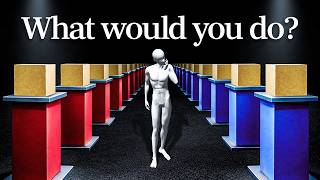
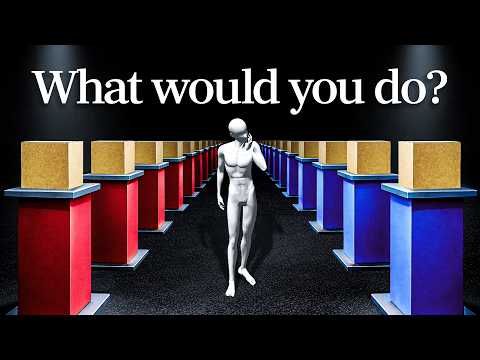
- The SetupThe ScenarioYou enter a room with a supercomputer and two boxes. One open box contains $1,000. A mystery box's contents depend on the supercomputer's prediction about your choice before you entered.The Rules• Take both boxes or just the mystery box • The supercomputer predicted your choice before you arrived • If it predicted you'd take one box, it put $1 million inside • If it predicted you'd take both boxes, it put nothing insideKey InformationThe supercomputer has accurately predicted thousands of people in similar situations with nearly perfect accuracy. It is not trying to trick you or deprive you of money.The QuestionDo you take both boxes or just the mystery box?
- The Two Camps EmergeThe DivideThe problem splits people into two roughly equal groups: one-boxers who take only the mystery box, and two-boxers who take both boxes. Philosopher Robert Nozick noted that each camp finds the other's position obviously wrong.The EvidenceA 2016 Guardian poll of over 31,000 people found 53.5% were one-boxers and 46.5% were two-boxers, nearly perfectly split.One-Boxer LogicOne-boxers argue that since the supercomputer accurately predicted thousands before, it will correctly predict them. Therefore, if they one-box, the $1 million will be there. Their expected utility is higher with one-boxing.Two-Boxer LogicTwo-boxers argue that the boxes are already set up and their decision cannot change what's inside. By strategic dominance, taking both boxes always yields $1,000 more than taking one box, regardless of the supercomputer's prediction.
- Decision Theories ExplainedEvidential Decision TheoryOne-boxers use evidential decision theory, basing their calculation on the supercomputer's proven accuracy. Evidence from thousands of correct predictions justifies expecting the $1 million when they one-box.Causal Decision TheoryTwo-boxers use causal decision theory, only considering things they can actually cause or influence. Since their current decision cannot change what was already placed in the box, they ignore the supercomputer's prediction and choose both boxes.The Hidden AssumptionBoth arguments are mathematically valid. The division comes from different assumptions about what matters: evidential decision theory values the supercomputer's predictive accuracy, while causal decision theory values only causality.Audience ResultsWhen Veritasium polled its audience with over 24,000 responses, two-thirds answered as one-boxers, showing the theory remains divisive.
- Rationality and the Winning TrapThe ParadoxThe only way to win $1,001,000 is to be a one-boxer mentally but two-box at the last second. However, if the predictor is perfect, this is impossible.Rationality Question• The rational act is to two-box and take both boxes • Yet in repeated games or society, one-boxers fare better • This shows rationality at the individual level differs from rationality at the societal levelThe Why Ain'cha Rich ArgumentOne-boxers end up with more money than two-boxers, leading philosophers Gibbard and Harper to argue the game is rigged. However, this reveals that sometimes acting irrationally is what makes a rational person successful.Key InsightPerhaps rationality isn't about choosing optimally in the moment, but about deciding what rules and commitments to live by.
- Real-World Stakes: Mutually Assured DestructionThe Cold War Context• By the mid-1960s, the US had over 30,000 nuclear warheads and USSR had over 6,000 • Secretary of Defense Robert McNamara advocated for 'assured destruction' strategy • Both sides could destroy each other multiple times overMutually Assured DestructionIf either country attacked first, the other would surely retaliate, leading to total annihilation. This commitment to retaliate, even when irrational in the moment, prevents attacks from happening.The DilemmaA president publicly commits to retaliate against a Soviet attack. When missiles launch, retaliation means nuclear winter killing nearly everyone on Earth. The rational choice in that moment is not to launch.The SolutionA good leader maintains the appearance of always retaliating while secretly willing not to. Credibly committing to an irrational action paradoxically produces rational outcomes.
- Pre-commitment and Living by PrincipleScenarios for One-Boxing• If choices now can change the past through a wormhole mechanism • If multiple trials occur, building reputation with each game • If you can pre-commit to a choice before the predictor decidesThe Game of ChickenIn chicken, the best strategy is to visibly throw your steering wheel out the window, proving you cannot swerve. This commitment to an irrational action forces the opponent to swerve, making you win.Dr. Strangelove ApplicationThe film depicts a Soviet doomsday device that automatically triggers nuclear annihilation. The tampering kill switch prevents the Soviets themselves from having second thoughts, making the device a credible deterrent.The Rule-Based ApproachRather than deciding what to do in the moment, decide what rules to live by. If you'd committed to one-boxing before learning the problem, you would one-box now because you live up to your pre-commitments.
- Life as Iterated CommitmentBeyond Single DecisionsLife doesn't end after leaving the room. You should always live according to the commitments that would've been good to make before facing any problem.Prisoner's Dilemma Lesson• In a one-shot game, defecting always gives more personal gain • In repeated games like life, cooperation becomes beneficial • Being a person who sticks to ideal pre-commitments creates better outcomesIdentity ShiftBy adopting the perspective that you've already made ideal pre-commitments, you reframe yourself as someone who one-boxes. This reframing doesn't require a new decision; it's living consistently with your best self.The RealizationYou may have been a one-boxer kind of person all along. It took reframing and perspective to see that living by principle is actually the most rational approach.
- Correlation vs CausationCore QuestionNewcomb's paradox is fundamentally about deciding if a strong correlation you know isn't causal should matter in your decision.The CorrelationThe supercomputer's predictions are strongly correlated with outcomes, but your present decision does not causally change what was already placed in the box.Broader Applications• How to determine if a drug really works or if effects are random chance • Distinguishing correlation from causation in real-world scenarios • Understanding what actually drives outcomes versus what merely correlates with themThe Learning OpportunityThis thought experiment with Brilliant's interactive courses helps build intuition about probability and reasoning through complex problems, applicable far beyond the paradox itself.