Most People Don't Know How Bikes Work
Most people don't know how bicycles actually work.
6 chapitres
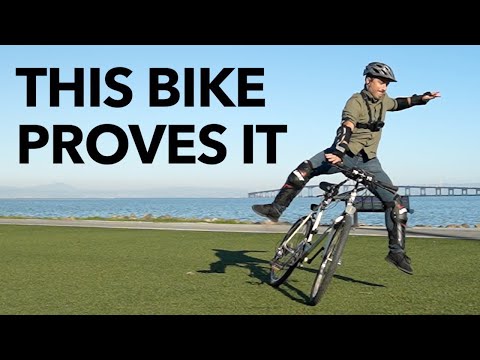
- Counter-Steering ExperimentThe SetupA modified bike with a radio-controlled locking mechanism demonstrates how steering actually works. Rick controls whether the host can turn left or right during riding.The Challenge• The host attempts to execute turns while the steering is locked to only one direction • When trying to turn in the locked direction, the bike becomes impossible to control • The host must look at an LED indicator to know which way steering is allowedKey DiscoveryTo turn right, you must first steer left, and to turn left, you must first steer right. This counter-steering is counterintuitive but essential to bike dynamics.Why It Happens• Steering affects both direction and balance simultaneously • Turning the handlebars right steers the bike out from under you, creating a left lean • The ground force then pushes you left, making a left turn • Counter-steering initiates the lean needed for the desired turn
- The Balance PrincipleCommon MisconceptionMost people think steering a bike is like driving a car: point the front wheels in the desired direction and go that way.The Real Mechanism• Steering affects both direction and balance • Riders use steering to keep the bike underneath their center of mass • This is identical to balancing a broomstick on your hand • The rider must move the base (steer) opposite to desired movementThe Inverted PendulumBiking is exactly like balancing an inverted pendulum. If you want to move the pendulum somewhere, you first move the base in the opposite direction.Unicycle Parallel• On a unicycle, forward pedaling requires first pedaling backward to lean forward • Everything is about keeping the contact patch in the right position relative to the rider • Longitudinal balance uses pedals, lateral balance uses counter-steering like a bike
- Stationary Bike Balance ProblemThe ProblemIt's much harder to balance on a stationary bike compared to a moving bike.False ExplanationMost people attribute this to the lack of gyroscopic effect from spinning wheels, but this is incorrect.Actual ReasonSteering only works when the bike is moving. When stationary, you cannot steer to keep the bike underneath you, making balance impossible.Continuous AdjustmentsEven when riding straight, riders constantly make small steering adjustments to maintain balance by moving the contact patch of the front wheel beneath them.
- Self-Stable Bikes and Gyroscopic MythThe MythMost people believe spinning wheels create a gyroscopic effect that keeps bikes upright, similar to how a spinning wheel resists falling over.Testing the Theory• A bike with completely locked handlebars cannot ride without a rider, even at high speeds • Multiple people attempted different techniques but could not keep it upright for more than a few seconds • Even the gyroscopic effect of spinning wheels was insufficientTrue MechanismBicycles are stable because they're designed to steer themselves through clever engineering, not gyroscopic effects.How Self-Steering WorksWhen the bike leans to one side, the handlebars automatically turn in that direction to steer the wheels back underneath the center of mass.
- Three Mechanisms of Self-SteeringCaster EffectThe front fork's angle causes the steering axis to intersect the ground in front of where the wheel touches. This works like caster wheels on shopping carts, forcing the wheel to align with the direction of lean.Mass DistributionThe center of mass of the handlebars and front wheel is located slightly in front of the steering axis. When the bike leans, their weight pushes the wheel in the direction of the lean.Gyroscopic AssistanceGyroscopic precession helps steer the bike through the principle that pushing one side of a gyroscope causes it to turn perpendicular to the applied force.FlexibilityA bike doesn't need all three mechanisms to be stable. Researchers created a bike without gyroscopic effect and caster effect that remains stable through mass distribution alone.
- Ongoing Research and Smart BikesActive ResearchUnderstanding how bicycles work is still an active area of research with programs that model different bicycle parameters and their stability ranges.Parameter AnalysisSoftware tools allow researchers to input different bicycle parameters and determine the speeds at which a bike becomes self-stable.Modern ApplicationsThis research is leading to better and smarter bikes, including prototypes with smart motors in the handlebars to actively steer and keep bikes upright even at low speeds.ConclusionMost people ride bikes without understanding the physics involved, yet cycling continues to advance through scientific discovery and innovation.