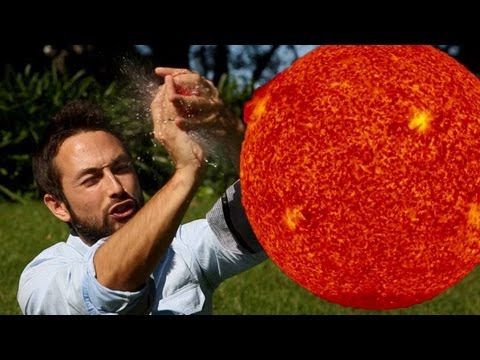
Where Does The Sun Get Its Energy?
4 chapitres
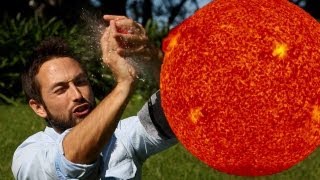
- Street Interview - Common MisconceptionsQuestion AskedWhat makes the Sun shine and where does it get its energy from?Common Answers• Chemical reactions or burning gas • Fire or burning air • Gas explosionsThe ProblemIf the Sun were just a giant ball of fire, it would have burned out after five billion years, yet it continues to shine.Key InsightThis is something people assume they know, but don't actually understand.
- Nuclear Fusion Basics - Protons and RepulsionSun's CompositionThe Sun is mostly made of protons and neutrons.Proton Behavior• Protons in the Sun dance and move together • When they come close, they bounce off each other • This happens because protons are positively chargedElectromagnetic ForcePositively charged particles repel each other due to the electric field - this is why protons bounce apart.Temperature's RoleThe Sun must be hot enough to make protons move so fast that they sometimes collide despite their repulsion.
- Fusion Process and Mass-Energy ConversionCollision ResultWhen protons smash together at high speed, they stick together and energy is released.Mass LossWhen protons fuse together, the resulting nucleus is lighter than the original protons - some mass is lost.Energy FormulaE = mc², where energy equals mass times the speed of light squared - this shows that a tiny amount of mass converts into a huge amount of energy.Solar ScaleEvery second, the Sun loses 4.3 billion kilograms of mass, which is converted into energy.
- Hydrogen to Helium Fusion CycleProcess OverviewIn the Sun, hydrogen fuses together to form helium through a multi-step nuclear process.Step-by-Step Reaction• Two protons collide, and one converts into a neutron while emitting a positron and neutrino • Another proton smashes in, releasing more energy • Two more particles collide, emitting two protons and leaving a helium-4 nucleusNet ResultHydrogen nuclei fuse into helium while losing mass that converts to energy.Why It WorksAlthough protons repel each other, they can fuse because the Sun is enormous with so much hydrogen that small collision chances happen constantly.