I Rented A Helicopter To Settle A Physics Debate
9 chapitres
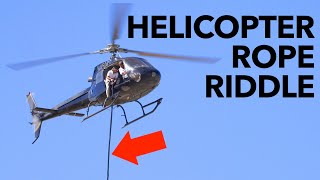
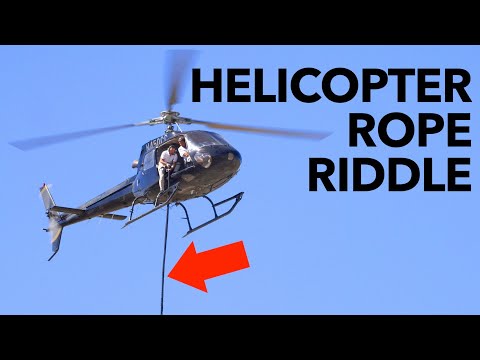
- The Physics Team QuestionThe ProblemA 2014 US Physics Team qualifying exam question asked which diagram best shows the shape of a flexible uniform cable suspended beneath a horizontally flying helicopter experiencing air friction.The Options• A: Hanging straight down • B: Hanging diagonally to the left • C: Hook shape • D: Inverted hook shape • E: S bendThe ControversyThere has been significant controversy about the correct answer to this question among physicists and students.The ApproachVeritasium rented a helicopter to conduct an actual experiment to settle the debate once and for all.
- Preparation and Expert InputHelicopter ExperienceThe pilot Craig has thousands of hours carrying sling loads, fire buckets, concrete buckets, and other objects that needed to be moved around mountains.Safety ConcernsThe main concern is that the rope could interact with the rotor wash, causing a whipping action that could potentially work its way back up towards the aircraft and get caught in the rotors or tail rotor.Question AuthorContact was made with Professor Paul Stanley, the question's author, who revealed that even faculty members and creative students who conducted their own experiments disagreed on the answer.Predictions• Most YouTube viewers predicted C • Physics experts predicted B, C, D, and A • No one predicted E
- First Experiment: Unweighted RopeSetup DetailsA battle rope approximately 15 meters long and weighing 20 kilograms was deployed from the helicopter while flying horizontally.Observed ResultThe rope hung in a diagonal line to the left, clearly demonstrating answer B.Forces Involved• Gravity pulling the rope downward • Air resistance acting to the left due to horizontal motion • These forces must be perfectly balanced by tension in the ropeKey FindingThe rotor wash does not extend far below the helicopter and dissipates quickly, so air resistance on the rope is entirely due to its motion through still air.
- Physics Explanation of Answer BTension Analysis• Rope can be divided into many short sections of equal weight experiencing equal air resistance • Tension at any section must balance the sum of air resistance and weight of all sections beneath it • Tension is zero at the bottom and increases linearly to maximum at the topDirection PatternAlthough tension magnitude changes throughout the rope, its direction remains constant because the ratio of air resistance to weight is the same at every point along the rope.Speed ImpactIf the helicopter flies faster, the angle of the rope changes, but it still makes a diagonal straight line because the ratio of air resistance to weight remains constant along the entire length.Why It WorksA uniform flexible cable hangs in a straight diagonal line when pulled at constant speed by a helicopter because both gravity and drag act uniformly along its length.
- Second Experiment: Weighted RopeEquipment ChangeA 20-pound kettlebell (approximately 9 kilograms) was attached to the end of the rope for this experiment.Predictions• Derek predicted option D • Others predicted B or C • One person predicted B after reconsideringObserved ResultFlying at nearly 100 kilometers per hour, the rope made an inverted J shape, which is answer D.Why It ChangedWith a large weight at the bottom, the tension must be nearly vertical to support the kettlebell. As you go up the rope, the ratio of total air resistance to weight increases, causing the rope to turn more horizontal to balance the increasing air resistance.
- Question Origin StoryDiscoveryProfessor Paul Stanley taught in Hong Kong and while hiking in the New Territories, he saw a helicopter flying with a cable carrying something to a remote area.Initial DesignThe cable Stanley observed had a weight hanging on the end, giving it a curved shape that looked counter-intuitive and interesting.Question RefinementWhen Stanley shared the observation with fellow Physics Olympiad coach Andrew Linn, Linn suggested making the question even more challenging by removing the weight on the cable.Educational GoalThe question was designed to be thought-provoking for the US Physics Team selection exam because the answer without a weight is harder to imagine.
- Third Experiment: Flag PayloadExperimental SetupA Veritasium flag was attached to the end of the rope, adding significant air resistance but minimal weight.Pilot PerspectiveThe pilot noted this was a science experiment showing things you would never do in normal helicopter operations, with risks including getting caught in either the tail rotor or main rotor.Observed ResultThe rope remained relatively straight despite the flag attachment, suggesting the flag did not add enough drag to significantly change the shape.Next StepDue to the unexpected result, the team decided to add a small parachute to the end of the rope to create more significant air resistance.
- Fourth Experiment: Parachute PayloadSafety PrecautionsThe parachute was bundled into a backpack to prevent it from flipping up into the rotors during deployment.Observed ResultWith the parachute at the end of the rope, it made a J shape, which is answer C.Physics ExplanationWith extra air resistance at the rope end but minimal weight, the tension must be nearly horizontal. As you go up the rope, the ratio of total air resistance to weight decreases, so the rope becomes more vertical to balance the increasing weight.Conclusion• Answer B occurs with an unweighted uniform rope • Answer C occurs with high air resistance and minimal weight • Answer D occurs with significant weight and moderate air resistance
- Experiment Conclusion and SponsorshipFinal FindingsDepending on what is attached to the end of the rope, the answer could be B, C, or D. The original physics exam question without any weight on the unweighted rope has answer B.Safety ReflectionHanging out the side of a helicopter was noted as not the safest moment, though Derek always feels safe at home.SimpliSafe Features• Customizable home security system shipped directly to doorstep • Interactive 24/7 professional monitoring • Base station, cameras, and sensors included • New wireless outdoor security camera with 8x zoom and color night visionSponsorship DetailsSimpliSafe sponsored the helicopter rental for this portion of the video. Visit simplisafe.com/veritasium to learn more and get at least 30% off the security system.