
How One Supernova Measured The Universe
4 chapitres
- The Unprecedented Supernova PredictionThe ChallengeScientists predicted that in November 2015, a star would go supernova in galaxy SP1149, billions of light years away—the first time anyone had attempted to predict a supernova.Why It's Rare• Supernovae are extremely unpredictable cosmic events • In any galaxy of 100 billion stars, only about two supernovae occur per century • Estimating when a large star will explode has significant error marginsSupernova Characteristics• Occurs when a star larger than 8 times the Sun's mass collapses and violently explodes • Can be as bright as an entire galaxy • Light follows a predictable pattern: bright for weeks, then fades over monthsThe Prediction SuccessThe Hubble Space Telescope captured images monthly starting October 30th, 2015. The supernova appeared exactly where predicted in the December 11th image, validating the scientists' calculations.
- Gravitational Lensing and Multiple ImagesThe RevelationThe scientists had seen this exact same supernova four additional times before in previous Hubble images—a year earlier and five months before their prediction.How Lensing Works• A massive galaxy cluster (MACS J1149.5+2223) between Earth and the supernova bent light through gravitational warping • Gravitational lensing magnifies distant sources and concentrates light rays • It can smear images of distant galaxies into arcs, strands, and unusual shapesTypes of Images• Einstein ring: occurs when source, lens, and telescope are perfectly aligned • Split images: when source and lens are spherically symmetric but misaligned • Einstein cross: four images in a cross shape when lens has elliptical asymmetryTime DelaysThe four supernova images appeared at different times, with delays ranging from 5 days to over 3 weeks. This timing variation could be measured because the supernova's brightness followed a distinctive pattern.
- The Cosmic Journey and Spacetime EffectsTimeline of Events• 9.3 billion years ago: the supernova explosion occurred • 5 billion years ago: the light encountered the massive galaxy cluster • An elliptical galaxy aligned with where Earth would eventually be, focusing the light raysPath DifferencesThe four paths the light took were different lengths, causing some images to arrive later than others simply because light had to travel further.Relativistic DelayLight passing through curved spacetime appears to travel more slowly relative to an external observer—a well-established part of General Relativity tested by Irwin Shapiro's 1964 radar experiments with Venus, which confirmed gravitational time delay predictions.Multiple Host Galaxy ImagesThe supernova's host galaxy itself appears three times in the image, also lensed by the galaxy cluster. Scientists used mass distribution models to predict the supernova would appear 20 years earlier in one host image (1995) and about one year later in another.
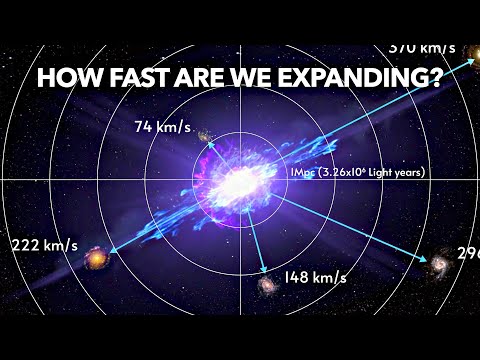
- Measuring the Universe's ExpansionThe Hubble Constant DebateAstronomers are debating how fast the universe is expanding, measured by the Hubble constant—the rate at which distant galaxies recede from each other depending on distance.Two Traditional Methods• Distance ladder method: uses nearby stars of known luminosity, yielding ~74 km/s per megaparsec • Cosmic microwave background analysis: studies early universe patterns using the Lambda-CDM model, yielding ~67 km/s per megaparsecThe DiscrepancyDespite refinements over years, both methods have not converged. The values now differ significantly enough to be nearly a 5-sigma result, which astrophysicist Joseph Silk called a 'possible crisis for cosmology.'A New SolutionMultiply-lensed supernovae, first proposed by astronomer Sjur Refsdal in 1964, offer an independent measurement method. Supernova Refsdal yields a Hubble constant value of 64 km/s per megaparsec, aligning more closely with cosmic microwave background measurements.