
How Does The Earth Spin?
2 chapitres
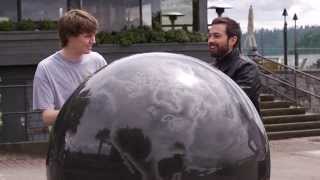
- Demonstrating Rotation with a GlobeExperiment SetupA globe is supported on a thin layer of water, allowing it to spin with minimal friction when force is applied to it.Observable Physics• The more force applied, the more the globe accelerates • Increased pushing power results in faster spinning speedsResistance Factors• Weight of the globe creates significant inertia (approximately 2 and 12 tons) • Even with water support, pushing requires considerable effort • The weight's center of gravity makes acceleration difficultKey InsightThe globe is easy to move but requires substantial force to accelerate it to high speeds due to its mass and inertia.
- Understanding Force and MotionInertia ChallengeThe spinning globe demonstrates that while a push makes it move, stopping the rotation is nearly impossible because of its momentum in the water.Force ConceptApplying a net or unbalanced force to an object causes it to change speed and accelerate.Core PrincipleForce causes change in speed—this fundamental principle of physics is demonstrated through the globe's response to applied force.Practical UnderstandingEven an 11-year-old can observe and articulate how forces affect motion, showing that physics principles are intuitive and observable in everyday experiments.