The Illusion Only Some People Can See
8 chapitres
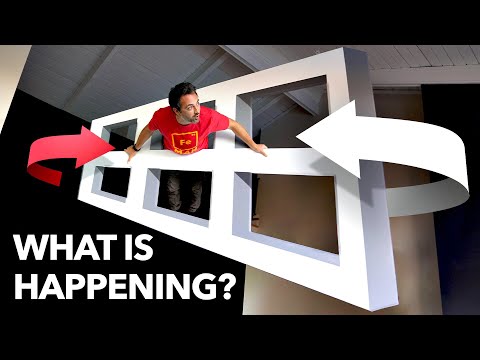
- Introducing the Ames Window IllusionThe ExperienceA rotating trapezoid window appears to oscillate back and forth rather than continuously rotate, creating a perceptual illusion that contradicts the actual motion.What's Actually HappeningThe window is mounted on a turntable and rotates continuously, but the trapezoidal shape causes the brain to misinterpret the motion as oscillation.Key Components• The window is a trapezoid, not a rectangle, with one side noticeably shorter than the other • Shading makes it appear three-dimensional despite being a flat 2D card • The same image appears on both sides of the cardThe ChallengeEven when knowing the exact construction and actual rotation, most people cannot perceive the continuous rotation and instead see oscillation.
- Testing with Physical MarkersRubik's Cube ExperimentAttaching a Rubik's Cube to the short side shows the cube rotating smoothly, but the window still appears to oscillate, and the cube appears to drift independently.Ruler Through the WindowA ruler placed through the middle of the window appears to pass through an impossible space, with the ruler rotating continuously while the window reverses direction.Brain's PreferenceThe brain consistently prefers interpreting the illusion over accepting the physically impossible continuous rotation it actually observes.Perceptual ContradictionThe visual system produces interpretations that violate physical laws, demonstrating that the brain prioritizes certain perceptual patterns over logical analysis.
- The Carpentered World HypothesisAdelbert Ames's TheoryThe illusion was created by Adelbert Ames in 1947, who theorized that humans are adapted to living in rectangular environments filled with 90-degree angles.Depth Perception Logic• Humans experience shapes as trapezoids on the retina due to viewing angles, but brains assume they are rectangles • Brains use trapezoid shapes to infer depth information • In rectangular environments, this inference is almost always correctSouth African StudyA 1957 Harvard study tested 80 South African children, with 40 from rectangular urban environments and 40 from round-hut rural communities. Urban children showed 60% susceptibility while rural children showed only 17.5%.Partial ExplanationAt greater distances and with one eye closed, 90% of all participants saw oscillation regardless of background, suggesting additional factors beyond the carpentered world hypothesis.
- Anamorphosis and Depth CuesAnamorphic TechniqueBoth the Ames window and similar illusions use anamorphosis, an artistic technique creating distorted projections that appear correct only from specific viewing positions.Historical Examples• The Ambassadors (1533) by Hans Holbein the Younger contains a hidden skull visible only from specific angles • Leonardo's Eye by Leonardo da Vinci appears correct when viewed from the side • Lascaux cave paintings (17,000 years old) may be early anamorphic art, accounting for uneven surfacesThe Ames RoomA distorted room constructed with a diagonal wall that appears normal from a privileged perspective but reveals distortion when people move through it, demonstrating infinite geometric possibilities creating identical perceptions.Depth AmbiguityThe brain uses visual cues like size, brightness, and occlusion to judge distance, but these can be manipulated to create situations that defy expectations and create ambiguous perceptions.
- Building the Large-Scale IllusionConstruction ChallengeCreating a large-scale Ames window required building a structure at least eight feet on its longest dimension from six pieces of plywood, glued and screwed together.Design Requirements• The structure needed to be very thin to approximate a two-dimensional object • Edges were beveled to maintain the thin appearance • Metal cables were twisted to hang it from the ceilingCritical FactorsEven lighting on both sides is essential to create a convincing oscillation illusion; uneven lighting reveals the actual rotation.How It WorksWhen the large side is close, the window appears to rotate correctly. When the large side moves to the back, it still appears larger in the field of view, so the brain perceives it as closer and rotating in the opposite direction, creating apparent oscillation.
- Infant Perception and DevelopmentDepth Perception TimelineDepth perception appears to be an innate ability that develops very early in human infancy, forming during the first several months of life.Research MethodResearchers tested babies in three age groups (5.5, 7.5, and 9 months) using the novelty preference method, where babies look longer at novel stimuli.Experimental Results• Five-and-a-half-month-old babies showed no preference for the Ames window over a rotating circle • Seven-and-a-half and nine-month-old babies were significantly more interested in the Ames window • This suggests older babies perceive the window as doing something different, presumably oscillatingImplicationBy around seven months old, infants have developed the ability to perceive depth cues and interpret the Ames window illusion.
- The Broader Philosophical MessageScientific AmbiguityThe illusion demonstrates that identical observational data can come from different external realities, challenging the idea that data alone determines which theory is correct.Historical Examples• Whether the sun orbits the earth or the earth rotates produces the same observable sun movement • Quantum mechanics offers multiple interpretations (wave function collapse vs. universe branching) with identical data • One-way versus roundtrip light speed measurements cannot be distinguished from current dataLife MetaphorJust as an Ames room can be constructed in infinite geometries that all look identical, reality contains infinite interpretations consistent with any given set of observations.Call for HumilityWhen many people receive the same information but reach different conclusions about reality, it's important to remember that simple visual illusions can fool our brains spectacularly, warranting humility and less certainty in our worldview.
- NordVPN SponsorshipReal-World ApplicationNordVPN helps users create the illusion of being in different locations worldwide, enabling access to region-restricted content like sports broadcasts.Content Access• Allows watching sports with blackout restrictions from alternative locations • Enables access to documentaries restricted to specific regionsPrivacy Features• VPNs prevent internet service providers from seeing visited websites • Useful when connecting to public Wi-Fi at cafes or while traveling • Helps minimize data exposure in an era of widespread data collectionSpecial Offer68% discount on a two-year plan plus four additional months free at NordVPN.com/veritasium using code Veritasium.