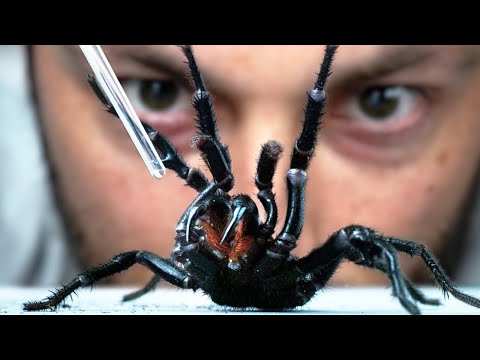
I Vacuum Venom from the World's Deadliest Spider
7 chapitres
- Introduction to Funnel-Web SpidersSetupDerek introduces a room containing hundreds of deadly funnel-web spiders hidden behind black curtains and explains the goal: to poke them, make them angry, and suction the venom from their fangs.Habitat & Behavior• Funnel-web spiders live around Sydney and build underground burrows with distinctive funnel-shaped webs at the entrance • They prefer dark, cool places but can end up in unexpected encounters with people due to their hiding behaviorBreeding Season DangerDuring breeding season, male funnel-webs leave their burrows at night to find females. If they venture too far and the sun comes up, they panic and hide in dark spots like piles of clothing or shoes, leading to accidental human contact.Fang & Venom Threat• Funnel-web fangs can be up to one centimeter long, longer than many snake fangs • Their venom is fast-acting and deadly • Australians often bang their shoes together before putting them on as a precaution
- Venom Toxicity and EffectsMale vs FemaleMale funnel-web spiders are milked exclusively because they are six times more toxic than females, producing higher quality anti-venom.Speed of DeathThe fastest recorded death from a male funnel-web spider bite is about 76 minutes in an adult, making it a very fast-acting, rapid venom.Chemical Mechanism• The venom contains a mixture of proteins, notably delta hexatoxin • It acts on nerve cells by stopping ion channels from closing, causing neurons to unleash floods of neurotransmitters like adrenaline • This causes muscles to receive rapid chaotic signals, leading to tensing and spasms • Eventually the body runs out of neurotransmitters, resulting in paralysis and heart or lung failureEmergency ResponseIf bitten, stay calm and still, apply a pressure immobilization bandage, and get to the hospital as soon as possible.
- Species-Specific ToxicityUnusual SensitivityHumans are particularly unlucky because funnel-web venom is not that deadly to most mammals like dogs, cats, or rabbits, but devastates primates including humans.Molecular TargetDelta hexatoxin binds to a specific site on sodium ion channels in primates, causing chaos, but that same binding site doesn't exist in other mammals.Evolutionary Accident• The spider evolved 40 million years ago, while humans arrived in Australia only 70,000 years ago • The venom originally evolved to kill insects and other invertebrates, not primates • It's an unfortunate coincidence that the venom is extremely deadly to humansAffected OrganismsThe venom affects invertebrates (their prey) and primates (monkeys, apes, and humans), making humans extremely vulnerable despite being accidental targets.
- Venom Collection and DonationCollection SourceThe Australian Reptile Park relies almost exclusively on public donations to maintain its spider collection, with spiders caught from backyards, swimming pools, and other locations.Spider Resilience• Funnel-web spiders can survive underwater for up to 30 hours by trapping tiny air bubbles in the hairs on their abdomen • A spider at the bottom of a swimming pool doesn't necessarily mean it's deadPreferred DonorsAdult, mature male spiders are preferred because they can be milked immediately without the facility having to raise them from younger stages.Why It MattersThe collected spiders provide the venom needed to produce life-saving anti-venom for the approximately 40 people bitten annually by funnel-web spiders.
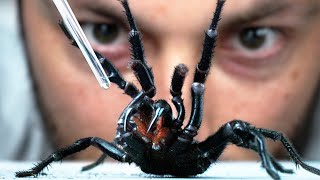
- Venom Extraction TechniqueProvocationTo extract venom, handlers poke the spider to trigger its defensive stance, where it raises up in the air and exposes its fangs.Venom FormationWhen provoked, the spider sometimes forms small drops of venom on the tip of each fang, making it ready for collection.Vacuum MethodA tiny vacuum is used like a pencil, stroking the tip of the fang to suction up the venom drops.Venom Quantity• Milking about 50 spiders per day produces around 250 drops of venom total • A single pipette of collected venom is enough to kill approximately a dozen adult humans
- Anti-Venom ProductionProduction ScaleProducing one vial of anti-venom requires milking 150 spiders by hand, a process that takes 12 hours.Lab Process• The frozen venom is sent to a lab in Melbourne • Rabbits are injected with gradually increasing doses of venom over six months to build up immunity • Rabbits are considered well-immunized once they can withstand six times the lethal doseAntibody ExtractionOnce rabbits build sufficient immunity, their blood is collected and spun on a centrifuge to separate out the antibodies that form the life-saving anti-venom.Why It WorksRabbits and humans are similar enough that rabbit antibodies can neutralize funnel-web venom inside human bodies, despite rabbits being far less vulnerable to the venom initially.
- Impact and PreventionAnnual IncidentsAround 40 people get bitten by funnel-web spiders each year, commonly from not checking their shoes in the morning.Life-Saving Success• No one has died from a funnel-web spider bite since 1981 • The anti-venom program has prevented deaths for over 40 yearsEffort RequiredThe work involved in milking spiders and producing anti-venom is significant, requiring 12 hours of hand-milking 150 spiders to save one person.Worthwhile MissionDespite the considerable effort, the program is considered worth it because it has eliminated deaths from what was once a fatal bite.