Math's Fundamental Flaw
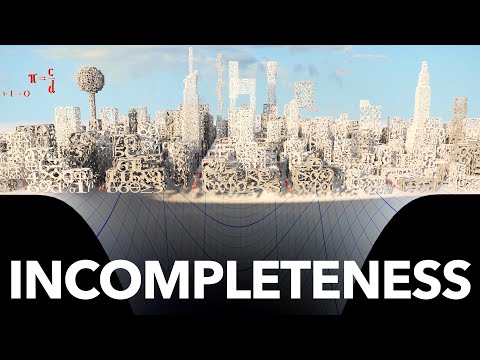
There is a hole at the bottom of math, a hole that means we will never know everything with certainty.
9 chapitres
- The Undecidable ProblemCore ConceptMathematics has a fundamental limitation: there will always be true statements that cannot be proven, even though no one knows exactly which ones they are.Example CaseThe Twin Prime Conjecture proposes there are infinitely many twin primes (prime numbers separated by one number, like 11 and 13). Despite primes becoming rarer as numbers increase, this conjecture remains neither proven nor disproven.Mathematical ImplicationAny system of mathematics capable of basic arithmetic will always contain true statements that are impossible to prove.Key InsightThis limitation is not a flaw in our current understanding but a fundamental property of mathematics itself.
- Conway's Game of LifeSystem DescriptionCreated by mathematician John Conway in 1970, this zero-player game operates on an infinite grid of cells that are either alive or dead.Basic Rules• A dead cell with exactly three live neighbors comes to life • A living cell with fewer than two or more than three neighbors dies • Rules apply automatically to generate successive generationsEmergent Behavior• Some patterns remain stable and never change • Others oscillate back and forth in loops • Some patterns like gliders travel across the grid forever • Many patterns die out, while a few keep growing indefinitelyThe UndecidabilityDespite simple rules, determining a pattern's ultimate fate is impossible. No algorithm can guarantee answering whether a pattern will reach a steady state or grow forever.
- The Crisis in MathematicsHistorical ChallengeIn the late 1800s, mathematician Georg Cantor's work on set theory challenged long-held mathematical assumptions, creating a fundamental crisis in the discipline's foundations.Cantor's Contribution• Proved that not all infinities are the same size using his diagonalization method • Demonstrated uncountable infinities are larger than countable infinities • Showed there are infinite hierarchies of infinitiesPhilosophical Divide• Intuitionists rejected Cantor's work as nonsensical, viewing mathematics as pure human creation • Formalists like David Hilbert embraced set theory and sought to place mathematics on rigorous logical foundations • Hilbert believed all mathematical truths could be proven through formal systemsThe StakesHilbert declared: 'No one shall expel us from the paradise that Cantor has created,' expressing confidence that set theory would solve all mathematical issues and secure the discipline's foundations.
- Russell's ParadoxThe ProblemBertrand Russell discovered that if sets can contain anything, including other sets and themselves, it leads to self-referential paradoxes that undermine set theory.The ParadoxConsider R, the set of all sets that don't contain themselves. If R doesn't contain itself, then it must contain itself. If R does contain itself, then it must not contain itself. This creates a logical contradiction.The Barber AnalogyA village has a barber who shaves all and only those men who don't shave themselves. This creates a paradox: if the barber doesn't shave himself, he must shave himself. If he does shave himself, he cannot shave himself.Resolution• Zermelo and other mathematicians restricted set theory definitions • The collection of all sets is no longer considered a valid set • This eliminated self-referential paradoxes while preserving set theory's usefulness
- Hilbert's Grand QuestionsThree Questions• Is mathematics complete? Can every true statement be proven? • Is mathematics consistent? Is it free of contradictions? • Is mathematics decidable? Is there an algorithm to determine what follows from axioms?Hilbert's ConfidenceAt a 1930 conference, Hilbert expressed absolute faith in affirmative answers, declaring: 'We must know, we will know.' These words were inscribed on his grave.The CrisisJust days before Hilbert's speech, 24-year-old Kurt Gödel announced he had proven the answer to the completeness question was no—a complete formal system of mathematics is impossible.Gödel's ImpactGödel's incompleteness theorem showed that Hilbert's formal systems dream was fundamentally flawed, overturning decades of work by the formalist school of mathematics.
- Gödel's Incompleteness TheoremThe MethodGödel assigned a unique number (Gödel number) to every symbol in mathematics. Using prime factorization, any mathematical statement or proof could be represented as a single number.The Self-ReferenceGödel constructed a statement that says 'This statement has no proof.' By assigning it a Gödel number equal to itself, he created a statement that references its own unprovability.The Consequence• If the statement is false and has a proof, then the proof shows there is no proof—a contradiction • If the statement is true, it means the mathematical system has true statements with no proofs—incompleteness • Either the system is inconsistent or incompleteThe ConclusionAny mathematical system capable of basic arithmetic must contain true statements that cannot be proven. Truth and provability are fundamentally different concepts.
- The Halting ProblemTuring's InnovationIn 1936, Alan Turing invented a theoretical computing machine to answer Hilbert's decidability question. The Turing machine has infinite memory, a read-write head, and a set of internal instructions.The QuestionCan you determine beforehand whether a program will halt (finish running) or run forever on a given input? This is known as the halting problem.Turing's Proof• Assume a machine H exists that can perfectly determine if any program will halt • Create a machine H+ that halts when H says a program never halts, and loops when H says it halts • Feed H+ its own code as both program and input • H must determine its own behavior, creating a self-referential contradictionThe OutcomeNo such machine H can exist. The halting problem is unsolvable, meaning mathematics is undecidable. There is no algorithm that can always determine whether a statement follows from axioms.
- Turing Completeness and Universal LimitsTuring CompletenessA system is Turing complete if it can perform any computation that a Turing machine can perform. Modern computers are Turing complete, as are many other systems.Universal Constraint• Wang tiles: their halting problem is whether they tile the plane • Quantum systems: their halting problem is determining the spectral gap • Conway's Game of Life: its halting problem is literally whether patterns halt • Programming languages, airline ticketing, magic the gathering, spreadsheetsThe PatternEvery Turing complete system has its own undecidable problem—a question that cannot be answered by any algorithm. This limitation is universal, not specific to any one system.Practical ImplicationEven a perfect complete description of a quantum system's particles is not always enough to deduce its macroscopic properties. Some questions are fundamentally unanswerable regardless of computational power.
- Legacy and ImpactThe Mathematics• Gödel proved mathematics is incomplete yet consistent systems cannot prove their own consistency • Turing proved mathematics is undecidable with no universal algorithm for proof • These limitations are fundamental features, not flaws waiting for solutionsComputational AchievementTuring's theoretical machine led to the first programmable electronic computer ENIAC, designed by Turing and John von Neumann after World War II. All modern computers descend from Turing's designs.Historical Context• Turing used his ideas to crack Nazi codes at Bletchley Park during WWII, estimated to have shortened the war by 2-4 years • After the war, the British government convicted him of gross indecency for being gay and forced him to take hormones • He died by suicide in 1954, never seeing how his ideas would transform the worldLasting TruthThe paradoxes arising from self-reference led to undecidability and computability theory, which spawned modern computing. The device you're watching this on exists because of Gödel's theorem and Turing's response to Hilbert's unanswerable questions.