Something Strange Happens When You Trust Quantum Mechanics
Everything is actually exploring all possible paths all at once.
16 chapitres
- The Lifeguard Problem and Light's PathThe MisconceptionA 42-year-old physicist admits to believing that every object has one single trajectory through space, one single path.Optimal RouteA lifeguard rescue analogy shows the optimal path is between a straight line and running down the beach, depending on running vs. swimming speeds.Light's MysteryLight follows the same optimal path principle, but the mystery is: how does light know to minimize its journey time without intelligence?The RevelationLight doesn't set out in only one direction; it explores all possible paths, as do electrons and all quantum particles.
- Action and Classical PhysicsMaupertuis ProposalAn obscure scientist proposed a quantity called action, defined as mass times velocity times distance, claiming everything follows the path that minimizes action.Hamilton's FormulationHamilton showed that action equals the integral over time of kinetic energy minus potential energy.Practical ApplicationAction provided an alternative way of solving physics problems, especially when Newton's laws became too cumbersome.Quantum RevolutionAround the turn of the 20th century, action appeared at the heart of quantum mechanics, the scientific revolution that would follow.
- The Blackbody ProblemHistorical ContextIn 1890s Germany, electricity was becoming widely available, and scientists sought to maximize visible light from hot filaments for light bulbs.Key Observation• At low temperatures, materials emit characteristic spectra mostly in infrared • Above 500°C, all materials glow identically with the same light distribution • Hotter objects emit more energy at every wavelength, with the peak shifting leftTheoretical ModelScientists modeled the simplest object: a hole in a metal cube, a perfect blackbody that absorbs all light entering and perfectly emits radiation based on temperature.Mathematical PredictionThe Rayleigh-Jeans law matched experimental data at longer wavelengths but predicted infinite energy at shorter wavelengths, known as the ultraviolet catastrophe.
- Planck's Quantum BreakthroughThe ScientistMax Planck was discouraged from studying physics at age 16, told it was a complete science, but he persisted and became a professor by 1897.The ProblemFor three years, Planck struggled to find a theoretical explanation for blackbody radiation, trying approach after approach without success.The SolutionIn an act of desperation, Planck restricted energy to come only in multiples of a smallest amount called a quantum, with energy proportional to frequency: E equals hf.The MysteryPlanck's formula matched experimental data perfectly, but he was troubled because he introduced a new physical constant (h) without understanding why it worked.
- Planck's Constant and Quantum ActionThe ConstantPlanck's constant h has the units of action and represents a quantum of action, the smallest possible amount of action in nature.The PrinciplePlanck proposed that any time any change happened in nature, it would be some whole multiple of this quantum of action.Initial ReceptionThe quantum of action received little attention initially until a 26-year-old patent clerk, Albert Einstein, appeared on the scene.Einstein's InsightEinstein claimed Planck's theory wasn't just mathematical but revealed that light comes in discrete packets (photons), each with energy hf, and used this to explain the photoelectric effect.
- Bohr's Atomic ModelThe QuestionNiels Bohr sought to understand why atoms are stable when they have positive nuclei with negative electrons orbiting them without spiraling inward.Angular Momentum LinkBohr realized electrons have angular momentum (mass times velocity times radius), which has the same units as action.The HypothesisWith no good reason, Bohr discretized orbital angular momentum, allowing electrons only in units of h-bar (h over 2π), with no justification.The SuccessBohr's model produced the correct energy levels of hydrogen; electrons jumping between orbits emit photons of specific colors, exactly reproducing the hydrogen spectrum.
- de Broglie's Wave-Particle DualityThe InsightLouis de Broglie proposed that if light could be both wave and particle, then matter particles could also be waves.Universal WavelengthEverything—electrons, basketballs, people—has a wavelength defined as Planck's constant divided by the particle's momentum (mass times velocity).Standing Wave ConditionFor an electron to stay bound in an atom, it must exist as a standing wave, requiring a whole number of wavelengths to fit around the orbital circumference.Physical ExplanationThis standing wave condition derives Bohr's quantized angular momentum, providing a physical reason: electrons are waves that constructively interfere only in stable orbits.
- The Double Slit Experiment RevealedThe SetupElectrons are fired one at a time through two slits to a detector screen; quantum mechanics says they must go through both slits simultaneously.Student's QuestionA student progressively asks: what if you add a third slit, fourth, fifth, and eventually infinite slits so the screen disappears?The LogicThe student's point demonstrates that particles always explore all possible paths, whether in a double slit experiment or traveling through empty space.Feynman's InsightThe student was Richard Feynman; while the story is made up, the logic is flawless—if you can't tell which slit the particle went through, it goes through both.
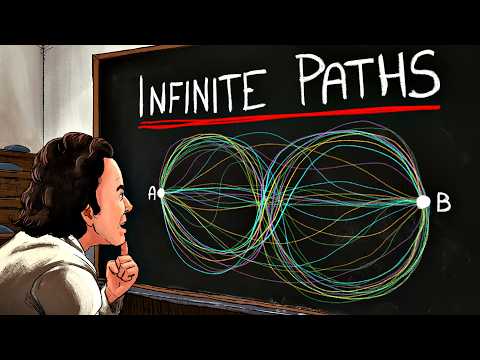
- All Possible Paths and AmplitudesFeynman's MethodParticles traveling from place one to place two must consider all possible paths, including ones faster than light speed and ones going back in time.Calculating ProbabilityEach path has an arrow representing its amplitude; to find the probability of a particle taking certain paths, add the arrows and square the result.The PhaseThe stopwatch measures phase, not time; as a wave takes different paths from point A to B, it arrives with different phases that determine wave amplitude.Mathematical ExpressionThe amplitude is e to the i phi, where phi is the phase; different paths produce different phases based on their distances and the wave's wavelength and frequency.
- Action Determines PhasePhase CalculationAs a particle wave follows a path divided into tiny sections, the phase increase in each section depends on wavelength and frequency.Mathematical Derivation• Substituting de Broglie's wavelength expression and simplifying with h-bar (h over 2π) • Replacing the sum with an integral as sections become infinitesimal • Expressing dx/dt as velocity to get mass times velocity squaredThe ResultThe integral becomes kinetic energy minus potential energy over time—precisely the classical action from earlier in physics.The SignificanceAction determines how fast the stopwatch (phase) turns; as particles move, action increases and phase increases accordingly.
- Why We See Single PathsPlanck's Constant ScalePlanck's constant h-bar is extremely tiny (about 10^-34 joule seconds), much smaller than the action of everyday objects.Random CancellationFor ordinary macroscopic objects, the phase spins zillions of times on ordinary paths, pointing in random directions; slightly different paths show even more phase rotation.Destructive InterferenceAlmost all possible paths have phases that cancel out through destructive interference, explaining why we don't see crazy trajectories.Constructive InterferenceOnly paths near the path of least action survive because they're at a minimum; tiny changes don't alter the action, so their arrows point the same direction.
- Classical Mechanics EmergesThe EmergenceClassical mechanics emerges from quantum mechanics through constructive interference of paths near least action.Massive ObjectsMassive particles have large actions compared to h-bar, so only paths extremely close to the true least-action path survive, making them very particle-like.Smaller ParticlesElectrons and photons have much smaller actions, so there's more spread in which trajectories they actually take.Universal PrincipleEverything explores all possible paths; what determines what we see is which paths interfere constructively based on their action values relative to h-bar.
- Feynman's Path DemonstrationThe SetupA light, mirror, and camera demonstrate that light takes infinitely many paths; according to Feynman, we must add contributions from all of them.Infinite PossibilitiesLight could go straight, bounce at various angles, or take any conceivable path—each with its own arrow that must be added.The AlignmentWhen the stopwatch arrows line up, we see the reflection; when light hits the mirror at normal angles, the reflection appears at the expected angle of reflection.Hiding the PathCovering the spot where light normally reflects shows that most other paths' contributions cancel out destructively.
- Diffraction Grating ExperimentThe MethodUsing foil with about a thousand lines per millimeter, covering half the mirror cancels out some destructive interference.Visible ResultWhen the foil grating is applied, light reflects from many spots instead of one, showing where partial cancellation allows hidden paths to appear.The Evidence• With foil: multiple reflection spots visible • Without foil: single normal reflection • With foil removed: normal reflection plus extra spots returnThe ProofThis demonstrates that light really does explore all possible paths, but most are normally cancelled out.
- Laser Diffraction ConfirmationInitial TestA laser shined at the mirror produces a single spot where expected; moving the laser away makes the reflection disappear.Foil ApplicationWhen the diffraction foil grating is placed over the mirror, the laser reflection appears even when shined off-axis where it normally would be invisible.Remarkable ResultThe laser light, when reflected off the patterned foil, reaches locations that shouldn't be illuminated according to classical optics.Proof of RealityThis shows that the cancellation of off-axis paths is real; using the grating to block destructive paths reveals that light truly explores all possible trajectories.
- Action's Importance in Theoretical PhysicsHistorical TeachingPhysics is taught historically, building up to least action, which is treated as the new kid on the block despite its fundamental importance.Modern UnderstandingTheoretical physicists rarely discuss energy or forces; instead, they talk about action, which is central to how they work on problems.Unified Framework• Different Lagrangians describe different domains: classical mechanics, special relativity, electrodynamics • Once you learn the Lagrangian framework, you can apply it the same way across all these areas • Different domains have their own Lagrangian that produces the correct actionThe Grand QuestionThe hunt for a theory of everything is really asking: what is the Lagrangian that can produce all the laws of physics in our universe?