
Chaos: The Science of the Butterfly Effect
The butterfly effect is the idea that tiny causes, like a flap of a butterfly's wings in Brazil, can have huge effects, like setting off a tornado in Texas
11 chapitres
- Introduction to the Butterfly EffectPopular Culture ImpactThe butterfly effect has inspired 61 movies, TV episodes, and short films on IMDB, plus prominent references in Jurassic Park, songs, books, and memesCommon UnderstandingIn pop culture, the butterfly effect means that even tiny, seemingly insignificant choices can have huge consequences later in lifeCore QuestionPeople are fascinated by the butterfly effect because it addresses a fundamental question: how well can we predict the future?Video ObjectiveExamine the science behind the butterfly effect to answer the question of future predictability
- Classical Determinism and Laplace's DemonHistorical ContextAfter Newton's laws of motion and universal gravitation in the late 1600s, everything seemed predictableNewton's Successes• Explained the motions of all planets and moons • Predicted eclipses and comet appearances with pinpoint accuracy centuries in advanceLaplace's Thought ExperimentPierre-Simon Laplace imagined a super-intelligent being (Laplace's demon) that knew everything about the universe's current state, concluding the future would be entirely determined and predictableTotal DeterminismThe view that the future is already fixed; we just have to wait for it to manifest itself
- Phase Space and Pendulum DynamicsPhase Space DefinitionA 2D plot representing every possible state of a system, with position on one axis and velocity on anotherPendulum with FrictionThe pendulum slows down over time, creating an inward spiral in phase space toward a fixed point attractor where it hangs at restPendulum without FrictionThe pendulum swings back and forth at the same amplitude, creating a closed loop in phase space that indicates periodic, predictable motionFundamental PrincipleCurves never cross in phase space because each point uniquely identifies the complete system state with only one possible future
- The Three-Body Problem and Early ChaosNewton's LimitationWhile calculating Earth and Sun's motion was simple, adding a third body like the Moon made the problem virtually impossibleHistorical StruggleNewton told his friend Halley that the theory of the Moon's motions made his head ache and kept him awake so often that he would think of it no morePoincaré's DiscoveryTwo hundred years later, Henri Poincaré realized there was no simple solution to the three-body problem and glimpsed what became known as chaosSignificanceThe three-body problem revealed fundamental limitations in predicting complex systems using Newton's laws
- Lorenz's Atmospheric DiscoveryThe SimulationMeteorologist Ed Lorenz created a computer simulation of Earth's atmosphere with 12 equations and 12 variables representing temperature, pressure, humidity, and other factorsThe AccidentWhen Lorenz re-entered numbers from a previous printout as a shortcut, the new run initially followed the old one but then diverged into completely different weather patternsRoot CauseThe printer rounded to three decimal places while the computer calculated with six, creating a difference of less than one part in a thousand that produced totally different resultsSensitive DependenceLorenz's system displayed sensitive dependence on initial conditions, the hallmark of chaos, where tiny input differences create dramatically different outcomes
- Understanding Chaos Through SimplificationSimplified ModelLorenz reduced his equations to just three equations and three variables representing a toy model of convection in a 2D slice of atmosphereChaos Properties• System is completely deterministic, identical to the pendulum in this regard • Identical initial conditions produce identical results • Any tiny difference in initial conditions gets amplified to totally different final statesThe ParadoxThe system is both deterministic and unpredictable because in practice you could never know initial conditions with perfect accuracyPractical ImplicationThis explains why even today with huge supercomputers, weather forecasts become no better than historical averages after eight days
- Phase Space Visualization of ChaosThree-Dimensional TrackingWith three variables, Lorenz's phase space can be plotted in three dimensions to visualize how the system evolvesDivergence DemonstrationThree closely spaced initial states initially evolve together but then start to diverge, ending up on totally different trajectoriesNo AttractorsUnlike simple systems, the chaotic system never revisits the same exact state and doesn't move toward fixed attractors or repeating loopsPractical ConsequenceYou could never release a double pendulum or similar chaotic system and make it behave the same way twice; its motion remains forever unpredictable
- Chaos in Multiple SystemsCommon Systems• Double pendulum: two simple pendulums connected together • Fidget spinners with repelling magnets: five spinners that appear regular but have strange motionsThe Solar SystemSimulations of our solar system for a hundred million years found it behaves chaotically with a characteristic time of about four million yearsFuture UncertaintyWithin 10 to 15 million years, some planets or moons may have collided or been flung out of the solar system entirelyUnexpected DiscoveryEven the system we think of as the model of order is unpredictable on modest timescales
- Fundamental Limits on PredictionPrediction DifficultyThe further into the future you try to predict, the harder it becomes, with predictions eventually becoming no better than guessesPast UncertaintyThe same applies when looking into the past of chaotic systems and trying to identify initial causesThe Fog MetaphorLike a fog that sets in the further we try to look into the future or past, chaos puts fundamental limits on what we can knowKnowledge BoundariesChaos limits what we can know about the future of systems and what we can say about their past
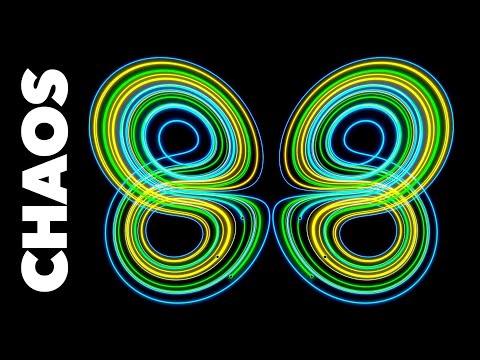
- The Lorenz Attractor and StructureSilver LiningDespite chaos limiting individual predictions, there is underlying structure in chaotic systemsThe AttractorWhen multiple initial conditions evolve together, they move toward a butterfly-shaped object called the Lorenz attractorStructure Properties• Paths traced never cross or form loops • Each path is an infinite curve in finite space • All trajectories converge to the attractor shapeDeeper InsightThough you cannot predict individual states, you can describe how collections of states evolve into recognizable patterns like the butterfly shape
- Conclusion and LastPass SponsorshipTrue Butterfly EffectThe science reveals that the butterfly effect is not just about unpredictability but also shows deep and beautiful structure underlying system dynamicsKey TakeawayWhile you cannot predict how any individual state evolves, you can describe how collections of states evolve into recognizable patternsPassword Safety AnalogyLastPass helps manage passwords by generating strong, unique codes for each website and auto-filling them, eliminating the need to remember or reuse passwordsFinal MessageHaving chaotic passwords is actually beneficial for security, unlike chaotic systems where unpredictability limits our understanding