
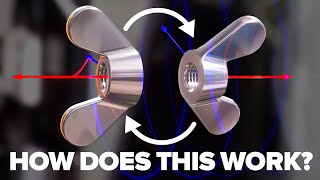

The Bizarre Behavior of Rotating Bodies
What you are looking at is known as the Dzhanibekov effect or the tennis racket theorem or the intermediate axis theorem
6 chapitres
- The Discovery in SpaceHistorical ContextIn 1985, Soviet cosmonaut Vladimir Dzhanibekov was tasked with rescuing the space station Salyut 7, which had completely shut down. After the rescue mission, he unpacked supplies locked down with a wing-nut.The PhenomenonAs the wing-nut spun off the bolt, Dzhanibekov noticed it maintained its orientation briefly, then flipped 180 degrees. It continued flipping back and forth at regular intervals without any applied forces or torques.Official SecrecyThe Russians kept this phenomenon secret for 10 years, suggesting it had significant implications that warranted classified status.Later PublicationIn 1991, a paper titled 'The Twisting Tennis Racket' was published in the Journal of Dynamics and Differential Equations, describing a related effect without mentioning the classified Dzhanibekov discovery.
- Understanding the Tennis Racket TheoremThree Rotation Axes• First axis: runs through the handle • Second axis: runs parallel to the head of the racket • Third axis: runs perpendicular to the head of the racketMoments of Inertia• Smallest moment of inertia: first axis (mass distributed closest to the axis) • Intermediate moment of inertia: second axis • Greatest moment of inertia: third axis (mass distributed farthest from the axis)Stability BehaviorRotations about the first and third axes are stable with no unwanted rotation. Rotation about the intermediate axis produces an unexpected half twist that cannot be prevented.Requirements for EffectThe effect requires an asymmetric top with three different moments of inertia about three principal axes. Objects with spherical symmetry or only two different moments of inertia will not demonstrate the tennis racket theorem.
- Historical Background and Feynman's ChallengeAncient OriginsUnderstanding of the intermediate axis theorem dates back at least 150 years to Louis Poinsot's book 'The New Theory of Rotating Bodies.' The concept is even found in classical mechanics textbooks like Landau and Lifschitz.Modern RecognitionIn space and microgravity, the effects appear striking and new to modern audiences, causing frequent social media questions about the phenomenon's validity and explanation.The Feynman QuestionFamous physicist Richard Feynman was asked if there was an intuitive way of understanding the intermediate axis theorem. After thinking carefully for ten or fifteen seconds, he replied 'No.'Solution ApproachThe video provides an intuitive explanation based on work by mathematician Terry Tao, Fields Medal winner, who posted an explanation on Math Overflow in 2011.
- Terry Tao's Intuitive ExplanationThe Model Setup• A thin rigid massless disc centered in a coordinate system • Heavy point masses on opposite edges of the x-axis • Light point masses on opposite edges of the y-axisMoment DistributionX-axis rotation has the smallest moment of inertia (only light masses moving). Y-axis rotation has intermediate moment of inertia. Z-axis rotation has the greatest moment of inertia (all four masses moving).Force AnalysisIn a rotating reference frame, centrifugal forces appear, pushing masses away from the rotation axis proportionally to their distance. When the disc is bumped from perfect y-axis rotation, small masses experience centrifugal forces that accelerate them.The Flipping Mechanism• Centrifugal forces accelerate small masses outward during the first half of motion • In the second half, centrifugal forces reverse, decelerating the masses • Masses come to rest on the opposite side and the pattern repeats indefinitely
- Earth Flip Speculation and RealityThe Bold HypothesisDzhanibekov attached a ball of modeling clay and observed it also flipped periodically, leading to speculation that Earth, as a spinning ball in space, could flip over similarly to the observed phenomenon.Conspiracy ConnectionIn 2012, during Mayan end-of-world prophecies, speculation about the Dzhanibekov effect became irresistible to conspiracy theorists. The Russian space agency RusCosmos published an article suggesting Earth could execute the same overturn during its orbital motion.Experimental Evidence• Astronaut Don Pettit showed books and solid cylinders spin stably about first or third axes • A liquid-filled cylinder spinning about the first axis becomes unstable • Liquids dissipate energy as they slosh, forcing rotation toward the maximum moment of inertia axisThe Real MechanismFor isolated objects in space, angular momentum stays constant but kinetic energy can be converted to heat. Bodies naturally evolve to spin about the axis with maximum moment of inertia, which represents the lowest energy state.
- Why Earth Won't FlipHistorical LessonThe U.S. Explorer One satellite was designed to spin about its long axis but rotated end-over-end within hours due to flexible antennas that dissipated energy gradually.Energy DissipationEarth has internal mechanisms to dissipate energy, causing it to naturally evolve toward rotation about the axis with maximum moment of inertia, which is stable.Planetary Patterns• Mars has a mass concentration (Tharsis Rise) at its equator, maximizing moment of inertia • Most asteroids rotate around the axis with maximum moment of inertia • This pattern is universal among astronomical objectsConclusionEarth is spinning about the axis with maximum moment of inertia, which is a stable configuration. Therefore, Earth will not flip.