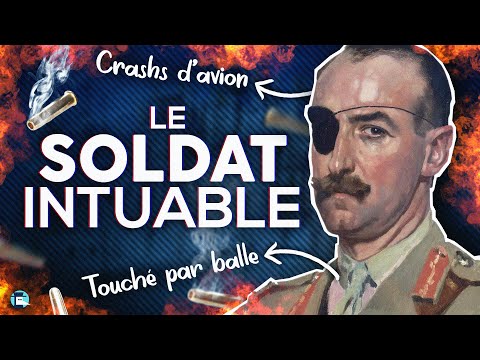
Le soldat qui ne voulait pas mourir - Sir Adrian Carton de Wiart
12 chapitres
- Introduction to Sabaton and Adrian Carton de WiartSponsor OverviewSabaton is a metal band passionate about history who have released their 11-track album 'The War to End All Wars', dedicated to the First World War and available on all digital platforms.Album Highlights• Covers the assassination of Archduke Franz Ferdinand • Features the Black American Hellfighters regiment • Documents the Battle of Doiran and British-Bulgarian confrontationSubject IntroductionToday's episode focuses on Sir Adrian Carton de Wiart, a man whose military career during the First World War is so extraordinary it seems unbelievable.Episode PreviewAn excerpt from Sabaton's song 'The Unkillable Soldier' introduces the story of this remarkable historical figure.
- Early Life and the Second Boer WarBirth and BackgroundAdrian Carton de Wiart was born in Brussels in 1880, spent his childhood in Egypt where his father was involved in English business, and was sent to England for education with hopes of attending Oxford and becoming a lawyer.Rejection of LawAdrian's true interests lay in sport and fighting rather than law. He freely admitted that all his life lacked was 'a good war' and was passionate about combat.First Combat• The Second Boer War broke out in South Africa in 1899 • Adrian was underage for enlisting, so he lied about his age and used the pseudonym 'Trooper Carton' • He was shot twice during his brief service: once in the stomach and once in the groin • He returned to England on a stretcher but remained convinced war was his true callingWar PhilosophyAdrian believed war revealed a man's true nature when faced with his fears. He found this phenomenon extraordinary and embraced his love of combat, despite knowing it was not normal.
- Military Career and the Camel CorpsArmy EnlistmentAdrian officially reenlistled in the British Army without lying about his age. However, barracks life and exercises bored him, and he made poor scores in theory exams, yearning for action.Somaliland MissionAt a quiet time, Adrian went to British Somaliland to fight local rebels. Unfortunately, his boat sailed on July 23, 1914, just days before the First World War began. He only learned of the war's outbreak upon arrival and desperately wanted to return.Camel Corps Combat• Adrian was forced to pacify villages in the desert on camel back instead of fighting in France • During an attack on rebels in a village, he was hit four times: his ear was slashed, shrapnel wounded his shoulder, he was wounded in the eye, and shot in the same eye • He refused to leave the battlefield with each woundFirst RepatriationAfter his wounds, Adrian was repatriated to England for surgery. Many soldiers would have taken a pension and left military service, but Adrian immediately begged to be allowed to fight the Germans instead.
- Return to France with DeterminationMedical Board ChallengeThe army medical board was reluctant to send Adrian back to the front because he was now blind in one eye and had been wounded multiple times. They worried the Germans would think the Army only had wounded officers left.Glass Eye SolutionAdrian suggested wearing a glass eye to fool the enemy. The medical board approved the idea, but Adrian threw away the glass eye and instead wore an eyepatch that made him look like a pirate, albeit a classy one.Belief in Destiny• Adrian was extremely superstitious and believed strongly in destiny • He believed that if it was not his time to die, he would not die, so there was no reason to hide from danger • When an officer urged him to take cover during bombardment, a shell killed the officer but left Adrian unharmed, confirming his beliefContinental Combat BeginsAdrian returned to France to fight the Germans on the continent, where his philosophy of embracing destiny would be tested repeatedly.
- Hand Loss and Continued ServiceIeper Raid WoundDuring a night raid at Ieper, Adrian's group of officers became lost and ran into a German sentry who opened fire, badly mutilating Adrian's hand.Self-Amputation• Coming out of the dressing station, Adrian immediately asked to return to the front • Two of his fingers were dangling off, but the surgeon asked him to wait for proper removal • Adrian bit off the fingers himself because he had other things to doSurgical DecisionAdrian was sent back to England where his hand wound worsened with multiple operations. Growing impatient, he requested the surgeons cut it straight off to be quicker, which they did without general anaesthetic as he didn't like it.Return to CombatThe medical board was reluctant to send a one-eyed, one-handed officer back to the front, but Adrian convinced them by explaining he'd successfully hunted birds during convalescence. In 1916, he returned to fight in France.
- Leadership at the SommeWeapons and Approach• Adrian refused to carry a revolver because he considered himself too dangerous when angered • His only weapon was an English officer's regimental baton, essentially a simple stick • His batman Holmes only carried Adrian's travel rug and camping stoveMemorable ImageryThe Germans must have found it extraordinary to see a one-eyed, one-handed officer armed only with a baton, followed by a soldier carrying a travel rug, emerge from the British trench and descend on them. Though they looked ridiculous, they were electrifying.Battle of the Somme• In 1916, Adrian was at the heart of the famous Battle of the Somme • His men were impressed watching him launch grenades by pulling out the pins with his teeth • He was an expert at leading and motivating his menMotivational TacticsWhen finding a soldier in a shell hole who claimed four wounds prevented him from continuing, Adrian hit him with his baton and declared that four wounds was nothing—he had far more and didn't stop. The soldier got up and advanced, later surviving to tell the King of England this story.
- Victoria Cross and Growing LegendVictoria Cross AwardAdrian was awarded the Victoria Cross, the British Empire's highest distinction, for taking command of decimated regiments in battle and leading them to victory with his baton, running under fire and leaping into trenches where men were paralyzed by bombing.Reputation Building• Adrian's reputation grew quickly throughout the army • Soldiers knew that seeing a moustachioed, one-eyed, one-handed officer appearing meant the joking around was over • A soldier hiding during an attack revealed himself immediately when he realized Adrian was asking for a revolverContinued Wounds• During an assault, Adrian took a machine gun bullet to the head but was fine • He was hit in the knee by a shell fragment • His ear was slashed again, but he refused to go to hospital for something so trivialRoyal Meeting and NationalityNear the front, Adrian met the King of England in person, who had heard so much about this unique officer and invited him to dinner. However, Adrian pointed out he was Belgian, not English, which the King found upsetting and asked him to rectify as soon as possible.
- Final Wounds and War's EndHolmes and the RugOne day Adrian found his batman Holmes prostrate and devastated—not wounded or shell shocked, but because a shell had landed close to him and destroyed Adrian's travel rug and camping stove, which Holmes considered an unforgivable crime.Hip Wound Crisis• Adrian took shrapnel to the hip while crossing during a German bombardment because his men needed him on the other side • One-eyed, one-handed, with a wounded knee, plus injuries to his ears, groin, and stomach, anyone else would have died multiple times over • This wound almost cost him his leg and he spent time in hospitalPriest's SurpriseA priest came to Adrian's hospital bedside and mentioned seeing worse—specifically a strange fellow months earlier who had lost both a hand and an eye. When Adrian asked the man's name, the priest answered 'Adrian Carton de Wiart,' realizing he was speaking to the same man.Armistice AchievementAdrian returned to the front one more time before the war ended. He reached the armistice as a true hero and archetypal English volunteer, still at his post despite an absolutely staggering number of wounds.
- Post-War AdventuresPoland Mission• After the First World War, England sent Adrian to Poland to help Poles fight the attacking Bolsheviks • Adrian was so effective and tenacious that not only were the English amazed, but grateful Poland offered him a manor house • Adrian disappeared from view for close to 20 years, retired in PolandSecond World War Return• When Poland was invaded by Germany in 1939, the sixty-year-old Adrian came out of retirement to return to combat • He managed to escape German forces and reach England • He obtained the leadership of commandos and returned to active combat in NorwayPlane Crash and Capture• While being sent to help the Yugoslavian resistance, Adrian's plane crashed into the sea—he survived • During his lifetime, Adrian survived several plane crashes, trusting his philosophy that if it's not his time, it's not his time • After this crash, he swam from the plane wreck to the coast but was captured and sent to a prisoner of war camp in ItalyItalian CaptivityAdrian made life hell for the Italians with his unstoppable escape attempts, to the point that they negotiated for his return to England. Once back, he became a special advisor to China's Chiang Kai-shek in the fight against the Japanese.
- Legacy and MemoirsChina and MaoNot only did Adrian make a name for himself as an advisor in China, but he even put Mao Tse-Tung curtly in his place during a meeting—something which clearly didn't often happen to Mao in his lifetime.Memoirs and Churchill• Adrian returned to England to write his memoirs • Winston Churchill wrote the preface to his memoirs • The book was titled 'Happy Odyssey,' documenting his participation in three wars and numerous woundsPolitical PhilosophyAdrian never entered politics himself because he hated it, but he wrote that he knew the value of politicians—without them there would be no war. Since he loved war, he thanked them.Final Years• Adrian passed away peacefully in 1963 at the age of 83 • When a journalist once asked what he thought of the First World War, his simple reply was 'Frankly? I enjoyed it.' • His autobiography 'Happy Odyssey' perfectly captures his extraordinary relationship with warfare and adventure
- Sabaton's 'War to End All Wars' Album Deep DiveBand Credentials• Sabaton has 6 gold records, 2 platinum records, and 2 billion tracks streamed • The band's entire body of work is dedicated to history • They have become iconic for connecting metal music with historical narrativesFamous Historical Tracks• 'The Last Stand' tells of the sacrifice made by the papal Swiss Guard during the Sack of Rome in 1527 • 'Primo Victoria' takes listeners into Operation Overlord in the Second World War • Their second WWI-themed album 'The War to End All Wars' features 11 tracksAlbum Structure• Opening track 'Sarajevo' tells of the assassination of Archduke Franz Ferdinand, the spark that ignited the war • Closing track 'Versailles' covers the Treaty of Versailles and the possibility of another imminent conflict • The album includes songs about the Macedonian Front, Italian Front, and the Battle of the YserNotable Historical Figures• The album features the Hellfighters, fearsome Black American soldiers from WWI • It showcases Milunka Savic, the most decorated woman in the First World War • It highlights Sir Adrian Carton de Wiart and other relatively unknown historical characters
- Sabaton Concert and Music-History ConnectionFestival ExperienceThe presenter has seen Sabaton in concert and interviewed them at Hellfest a few years ago while reporting on the links between History and Metal music.Music-History Appeal• Exploring history through music provides an engaging alternative to traditional thesis-based learning • At Hellfest, when festival-goers were asked what made them appreciate history, Sabaton was in the top three names they gaveAlbum AvailabilityThe album 'The War to End All Wars' is available on all digital music platforms including Spotify, Deezer, and iTunes, as well as in usual retail stores.Closing RemarksThe presenter expresses excitement about partnering with Sabaton and encourages viewers to discover the album for themselves through various platforms and stores.