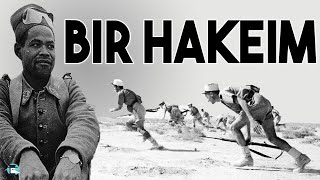
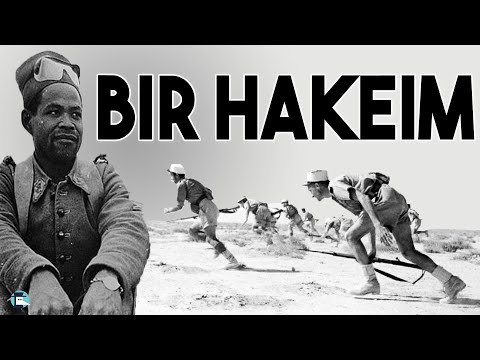
Survivre au milieu du désert - La bataille de Bir Hakeim
5 chapitres
- Introduction to Bir HakeimWhat is Bir HakeimBir Hakeim is known in Paris as a magnificent bridge featured in films like Inception, and also as a metro station and various streets in other cities. However, historically it refers to a well of water lost in the middle of the Libyan desert.Historical ContextThe story takes place in the spring of 1942 during World War II in Libya, involving General Rommel and the Afrika Korps against British forces.Geographic Importance• The British were defending a line in front of Tobruk, their last major base in Libya • If Tobruk fell, German forces would have access to Egypt and the Suez Canal • The Suez Canal was crucial for transiting troops and equipment between the Mediterranean and Red SeaStrategic PlanGeneral Rommel's strategy was to occupy British forces along their main line while using a fast mobile troop to bypass the southern point of defense and attack from behind. Bir Hakeim was the southernmost point of the British defense.
- The Unexpected ResistanceDefense AssignmentGeneral Ritchie of the 8th British Army assigned the defense of Bir Hakeim, a tiny desert post with a dry well, to the 1st Free French Brigade. He did not expect an attack at this location.First Assault• On May 27, 1942, Rommel launched a diversion attack followed by his main movement • Italian troops were ordered to seize Bir Hakeim while Rommel bypassed the ruins to attack the British from behind • The Italians were pushed back in less than an hour and left thirty-two tanks on the groundFrench CounterattackThe French not only repelled the Italian assault but also attacked Rommel's troops from behind, forcing Rommel to abandon his offensive against the English to destroy the French position that threatened his rear.French Forces Composition• Led by General Marie-Pierre Koenig, an officer with years of experience in North Africa • Included troops from Africa and the Pacific, marines, and two battalions of the Foreign Legion • Surrounded by minefields with guns of all kinds and Royal Air Force support • Men lived in individual holes and vehicles were buried for protection
- The Siege and BombardmentSiege StrategyRommel isolated the position and began bombardment, demanding French surrender. From June 2 to 10, 1942, 40,000 enemy shells fell on the French entrenchment, plus bombs from Axis planes.French Response• The French returned fire with 42,000 shells • Anti-aircraft support worked with the RAF to repel enemy aviation • Three times Rommel demanded surrender; three times the French responded with cannon fire and raids against enemy positionsNotable Actions• Aspirant Jean-Charles Bellec and his men infiltrated enemy lines to obtain information • French forces passed whole convoys of water and ammunition through Axis defenses • Rommel bombed transmission stations, but they were restored each time, notably by Captain Jacques Renard (real name Jacob Kramer), a German officer ironically serving in the LegionHuman CostFelix Brooch, commanding the Pacific Battalion and nicknamed 'The Father' by his Tahitian troops, died in shelling alongside his deputy. Officers fought alongside their men without protection from fire.
- Breakout and VictoryStrategic AchievementThe French resistance unexpectedly allowed the entire English army to reorganize while the French brigade occupied Rommel. The German general moved in person to try taking the position but failed.Night Escape• On the night of June 10-11, 1942, the English asked the French to fall back • Commander André Gravier of engineering directed the operation to cross enemy lines and minefields at night with minimal attention • Gravier was seriously injured by a shell while personally guiding his convoy • The French successfully escaped during the night operation on June 11Rommel's AssessmentRommel wrote: 'Once again, the proof was made that a French chief, decided not to throw the rifle after the sight at the first opportunity, can perform miracles, even if the situation is apparently hopeless.'Casualties and Outcome• French lost more than 1,000 men: dead, wounded, missing, or prisoners, plus vehicles and guns abandoned • This represented almost a third of the workforce present • 2,500 men regained the English lines ready to continue fighting • Enemy forces were 10 times larger; Rommel lost 14 days without defeating the French
- Legacy and ImpactHistorical SignificanceThe Battle of Bir Hakeim was hailed worldwide. The Free French Forces successfully put Rommel's plans in failure despite isolation and an overwhelming imbalance of forces.Strategic Consequences• The 14 days gained allowed the English to reorganize around a new line of defense • This halted the advancing Afrika Korps • It led to the famous Battle of El Alamein, which would prove equally importantDistinguished Officers• Koenig, Renard, Bellec, Gravier, and Brooch were all Companions of the Liberation • Many continued to serve in political action after the war • Koenig became Minister of DefenseCultural MemoryThe Museum of the Order of the Liberation has a showcase dedicated to this battle. The battle stands as evidence that French troops fought successfully during World War II, countering the narrative of French surrender.